Bill 26 (The Miscellaneous Statutes Repeal Act, 2025)
Second Reading
From Hansard (3 November 2025)
To view this section on video, click here and start play at 3:05:20 PM.
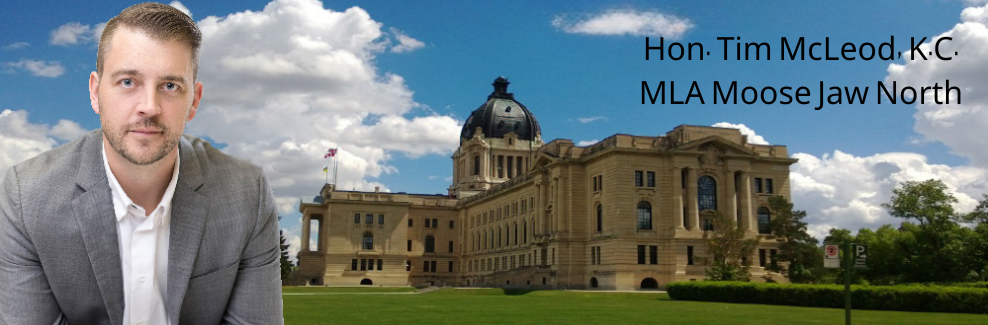
Hon. Tim McLeod: — Thank you very much, Mr. Speaker. I rise today to move second reading of Bill 26, The Miscellaneous Statutes Repeal Act, 2025. As part of the Ministry of Justice and Attorney General’s red tape reduction commitment, this bill will repeal many outdated Acts that no longer serve a purpose.
Two obsolete public Acts will be repealed along with over 100 private Acts related to organizations that are no longer active in any capacity. In addition, over 80 older private Acts related to municipalities have been identified as no longer necessary.
Mr. Speaker, to offer just a few examples of outdated Acts that no longer serve a purpose, this bill will repeal an Act respecting the city of Regina’s street railway system from 1910, and An Act to confirm a Certain Bylaw of the City of Saskatoon regarding the Street Railway from 1912 will also be repealed. Mr. Speaker, these bills were passed to allow Saskatoon and Regina to operate street cars. Saskatoon’s street car system ran until the 1940s and Regina’s operated until 1950. Saskatoon and Regina have both indicated they have no intention of operating street car systems any time soon, leaving these Acts without any meaningful purpose.
Research and consultations were carried out to ensure that the repeals in the Act will have no substantive impact on stakeholders or government, Mr. Speaker. Relevant municipalities were notified of the proposed repeals.
Mr. Speaker, I am pleased to move second reading of Bill 26, The Miscellaneous Statutes Repeal Act, 2025.
Standing Committee on Intergovernmental Affairs and Justice
From Hansard (26 November 2025)
To view this section on video, click here and start play at 4:00:35 PM.
Clause 1
Chair B. McLeod: — So consideration of Bill No. 26. Today we are going to be considering two bills, and we will first consider Bill No. 26, The Miscellaneous Statutes Repeal Act, 2025 beginning with the consideration of clause 1, short title.
Minister McLeod is here with his officials, and I’d ask first of all that you please introduce them. And before they speak the first time, and when they speak to be introduced, please do not touch the microphones, as is usual. Hansard is going to look after that for you.
So, Minister, please introduce your officials and make your opening comments, please.
Hon. Tim McLeod: — Very good. Thank you very much, Mr. Chair. Joining me today I have Darca Tkach, Crown counsel, legislative services to my right, and Jared Pashovitz, acting registrar of corporations, office of public registry administration to my left.
Mr. Chair, I would now offer opening remarks for Bill 26, The Miscellaneous Statutes Repeal Act, 2025. As part of the Ministry of Justice and Attorney General’s red-tape reduction commitment, this bill will repeal many outdated Acts that no longer serve any purpose.
Two public Acts that are no longer needed will be repealed: The Companies Winding Up Act and The Saskatchewan Opportunities Corporation Act. The office of public registry administration has found over 114 private Acts related to organizations that are no longer carrying on business or activities or continued under current legislation. In addition, 84 older private Acts related to municipalities have been identified as no longer necessary.
Research and consultations were carried out to ensure that these repeals will have no substantive impact on stakeholders or government. Relevant municipalities were all notified of the proposed repeals.
Mr. Chair, with those opening remarks, I welcome questions respecting Bill 26, The Miscellaneous Statutes Repeal Act, 2025.
Chair B. McLeod: — Thank you, Minister. I will now open the floor to any questions. MLA [Member of the Legislative Assembly] Sarauer.
Nicole Sarauer: — Thank you, Mr. Chair, and thank you, Minister, for your opening comments. I just have a few questions with respect to this bill.
Minister, you had mentioned that there had been research and consultation regarding the repeal of these pieces of legislation. Could you provide some further information as to the work that happened and the feedback that was received?
Hon. Tim McLeod: — Certainly. I’ll start maybe with the private Acts. The office of public registry administration did the consultation and investigation on that, so perhaps I’ll let Jared speak to that.
Jared Pashovitz: — Sure. So yeah, there were significant consultations that occurred for this matter. And sorry, I should follow the protocol. I’m Jared Pashovitz and I’m the acting registrar of corporations.
And so essentially what happened was OPRA [office of public registry administration] identified the entities and the legislation that created these entities that, you know, we felt were subject to this. And so the first step was for OPRA to actually look into the corporate registry and determine if these entities were active or not. And if they weren’t, we’d follow up with further research, involving archival work, you know, looking at the historicals, like seeing if there were any entities that they had subsequently . . . Sorry, I’ve lost my train of thought here. Let me restart.
Darca Tkach: — I could make some comments on it.
Jared Pashovitz: — Sure. No, I’ll be . . . I’m fine. But maybe start and I can fill in with some of them. Sorry, Darca.
Darca Tkach: — I’m Darca Tkach, Crown counsel at legislative services. So OPRA conducted quite a bit of research to find out if there was still any representative of an entity who could give instructions to repeal the Act. And in some cases, we were able to find a representative who could give instructions.
In other cases, in the absence of a representative who could give instructions, OPRA conducted research. For example, they looked to see if the entity had continued under modern legislation, which in some cases, it had. They looked at online historical sources or documents to see if there was a reference to the entity still being active or any membership in the entity.
They checked to see if the entity was licensed or registered with FCAA [Financial and Consumer Affairs Authority of Saskatchewan] or if it was a registered charity still with Canada Revenue Agency, and if the entity was active in the Information Services Corporation. And if they could not find many references, the list of Acts to be repealed was posted in The Saskatchewan Gazette, and anyone associated with those Acts and entities was encouraged to contact OPRA. And no objections were made.
Nicole Sarauer: — Thank you. For the entities that you were able to get in contact with, did you have any entities express a desire to keep their private Act alive?
Darca Tkach: — There were some entities, I believe, that we needed to have further discussion with them about whether or not they wished to have the Act repealed. But if there were any concerns, we left it for now and we could return to those later.
Nicole Sarauer: — So just for clarification, to reiterate what you just said, any entities that you were able to speak with who were comfortable having their Acts repealed are included; any ones who had concerns are not included in this legislation?
Darca Tkach: — Yes, any entities with whom we had to have further discussion were not included.
Nicole Sarauer: — Could you explain for the committee why it may be necessary or not to maintain private Acts for entities when they could theoretically easily file under The Non-profit Corporations Act or The Business Corporations Act?
Darca Tkach: — Well usually the reduction of private Act entities is beneficial because private Act entities are not held to the same standard as entities created under public Acts. For example, there is no requirement for them to keep their information up to date or to do financial reporting. And also I should say having out-of-date information in the corporate registry means that people relying on the corporate registry could have incorrect information there, and bad actors could use the identities for fraudulent purposes. So it is beneficial to reduce the number of private Acts.
Nicole Sarauer: — Is it the ministry’s goal to reduce the amount of private Acts to zero?
Darca Tkach: — Well there are a couple of options for further reducing the number of Acts. Right now OPRA has taken a research-based approach to determining if a private Act should be repealed. But another option would be for the government to set a deadline and say that any entities still affected would need to continue as a non-profit or continue as a business corporation and set a deadline for that to happen.
Hon. Tim McLeod: — If I could, just on that point, I would say that it’s the government’s intent to reduce red tape and to clean up old, archaic Acts that are no longer being used, not to address ones that are simply because they’re a private Act. I would say that, as Darca outlined, any entity that even needed a further conversation isn’t included in the legislation. These are all pieces of legislation that are archaic and unnecessary, and it’s simply a red-tape reduction exercise.
Nicole Sarauer: — Could you speak a little bit further about next steps? You’ve indicated that there are some entities where further consultation is required. Could you talk about what the next steps are with respect to those entities and perhaps if there are any others that need to be addressed?
Darca Tkach: — Well currently there’s about 300 private Acts on the King’s Printer website. This bill would repeal about 198 of them, and that leaves about slightly over 100 private Acts still in existence. And we would need to do further research on those, have further discussions with the entities.
Private Act entities sort of are considered other legislative entities and occupy a bit of a unique position. As I outlined, private Act entities are not subject to the same regulatory oversight as public Acts. So we would need to do some further work into the remaining Acts.
Nicole Sarauer: — I’m wondering, Mr. Pashovitz or anybody else, if you could speak to the benefit that this red-tape reduction will have for the corporate registry?
Jared Pashovitz: — So the corporate registry, it’s relied upon to be accurate, right. As a registry officer, we want the most accurate information in that registry. The importance of bringing in some of these Acts into our modern legislation, our modern business corporations Act and modern non-profit corporations Act, there are mechanisms in that legislation that require those entities to file regularly. So file updated corporate information, addresses, you know, that type of information. So from an integrity of the registry perspective, this is a great initiative. And the people of Saskatchewan rely on that information being accurate in the registries.
Nicole Sarauer: — Thank you. No further questions.
Chair B. McLeod: — Seeing no more questions, and thank you. We will proceed to vote on the clauses. Now the bit of the fun part. This bill has over 200 clauses — 202 to be exact. And if the committee is in agreement, we’re going to review the bill by parts. So if that agreement is there? Agreed.
We’re in agreement. That still means that I have to initial each clause, all 202 of them, so it’s going to take some time. But we have four parts and the first three will go rather quickly, but that will save me from saying “agreed” and “carried” 198 times. So I appreciate that indulgence.
So we’ll get started here. And you’ll have to be patient with me as I initial. I do have to initial as we go. And we’ll get started right away here then.
So part 1 is the preliminary matters. And clause 1, short title is that agreed?
Some Hon. Members: — Agreed.
Chair B. McLeod: — Carried. And I will start my initialling.
[Clause 1 agreed to.]
[Clauses 2 to 201 inclusive agreed to.]
Chair B. McLeod: — Now the fun part, where you get to watch me initial all these pages. And I’ll start here. And I’m not sure what you’re going to do for entertainment while I do this, but you go ahead.
And so part 4, coming into force. Clause 202, coming into force, is that agreed?
Some Hon. Members: — Agreed.
Chair B. McLeod: — Carried.
[Clause 202 agreed to.]
Chair B. McLeod: — His Majesty, by and with the advice and consent of the Legislative Assembly of Saskatchewan, enacts as follows: The Miscellaneous Statutes Repeal Act, 2025.
I would ask a member to move that we report Bill No. 26, The Miscellaneous Statutes Repeal Act, 2025 without amendment. MLA Jamie Martens moves. Hon. Jamie Martens moves. Is that agreed?
Some Hon. Members: — Agreed.
Chair B. McLeod: — Carried. Any closing comments by the minister or members?
Hon. Tim McLeod: — No, I would just thank the committee for their consideration and the Chair for his initialling exercise.
Chair B. McLeod: — Thank you very much. Any closing comments?
Nicole Sarauer: — Other than echoing the minister’s comments in thanking the committee as well as yourself, Mr. Chair, and the officials for their thoughtful responses to my questions today.
Chair B. McLeod: — Thank you so much. I note with interest in the ones that I initialled that my town of Caron, incorporated as a town, was repealed. I’m happy that we’re still an organized hamlet, but I saw with interest that one as I was looking at the bill earlier today.
Back to 2025/2026 Session
Constituency Office
Constituency Assistant: Jacqui Stephens
200 – 99 Diefenbaker Drive
Moose Jaw, SK S6J 0C
Telephone: (306)-692-8884
Fax: (306)-693-3251
Email: mjnorthmla@sasktel.net
Hours of Operation:
Monday to Friday from 8:30 to 12:00 and 12:30 to 4:00