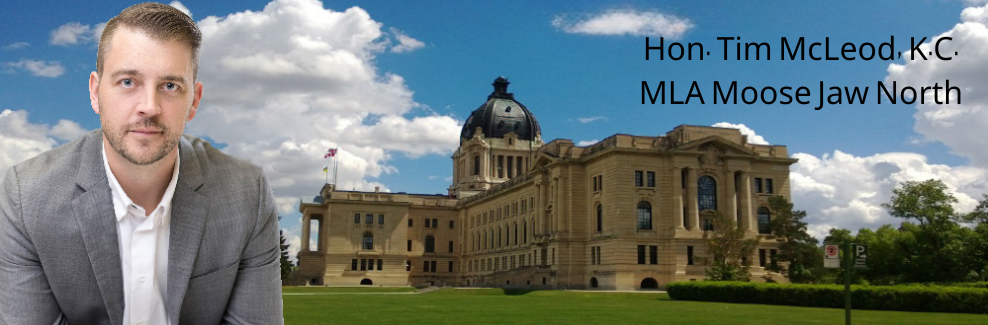
Bill 47 (The Response to Illicit Drugs Act)
Second Reading
From Hansard (4 December 2025)
To view this section on video, click here and start play at 2:46:15 PM.
Hon. Tim McLeod: — Thank you very much, Mr. Speaker. The Government of Saskatchewan remains committed to protecting families and communities from the dangers of illicit drugs. Mr. Speaker, the government is dedicating significant resources to assist those who are suffering from addictions. However we also need to take action against people who profit from illegal drug production and trafficking. This Act will achieve this goal through two sets of rules.
The first: the Act will create a statutory cause of action against drug offenders for both the government and individuals who are harmed by drug offenders. This will allow government to recover costs resulting from actions of drug traffickers and producers, such as health care costs.
Similarly individuals who are personally harmed by a drug offender may bring an action against that offender to seek damages. Mr. Speaker, the Act assists these individuals by creating a rebuttable presumption against the drug offender. The onus is on the defendant drug offender to demonstrate that they did not cause harm to the plaintiff.
Secondly, the Act deems certain appointments, grants, or agreements that are made or entered into by government to be voidable if the other party is convicted of a drug offence. The government will have discretion to determine the appropriate action in each case and ensure that drug offenders face appropriate professional and economic consequences for their actions.
Mr. Speaker, this new Act applies specifically to persons who contravene drug production and trafficking offences under the federal Controlled Drugs and Substances Act. It does not apply to individuals who are convicted of simple possession offences. This approach ensures the Act is focused on those individuals who are profiting from illegal drug trade rather than the individuals who are suffering from addiction.
Mr. Speaker, I am pleased to move second reading of The Response to Illicit Drugs Act.
Standing Committee on Intergovernmental Affairs and Justice
From Hansard (22 April 2026)
To view this section on video, click here and start play at 4:24:30 PM.
Chair B. McLeod: — Next we have consideration of Bill No. 47, The Response to Illicit Drugs Act, beginning with clause 1, short title. Minister McLeod, you’re back with new officials, and I certainly want you to know as well, don’t touch the mikes and identify yourself the first time that you speak.
So, Minister McLeod, please introduce any new officials and make again your opening comments.
Hon. Tim McLeod: — Thank you very much, Mr. Chair. Joining me at the table to my left is Neil Karkut, senior Crown counsel with legislative services; and to my right, Darcy McGovern, K.C. [King’s Counsel], executive director of public law division. Joining me behind as well we have my chief of staff, Max Waldman, as well as Maria Markatos, K.C.
Mr. Chair, I will offer brief opening remarks for Bill 47, The Response to Illicit Drugs Act. This Act forms part of the government’s commitment to protect families and communities from the dangers of illicit drugs. The Act targets people who profit from illegal drug production and trafficking in two ways.
First, the Act creates a statutory cause of action against drug offenders, both for the government and for individuals. This allows government to recover costs caused by drug traffickers and producers, including health care costs. Individuals who are personally harmed by drug offenders may also bring an action against the offenders to seek damages.
When an individual brings a claim, the Act creates a rebuttable presumption against the defendant drug offender. The onus is then on the defendant to demonstrate that they did not cause harm to the plaintiff.
Second, the Act deems certain government appointments, grants, or agreements voidable if the other party is convicted of a drug offence. The government has the discretion to determine the appropriate legal action in each case and make sure drug offenders face appropriate professional and economic consequences for their actions.
This Act applies to persons who contravene drug production and trafficking offences under the federal Controlled Drugs and Substances Act. It does not apply to individuals convicted of simple possession offences. This approach focuses on individuals who profit from the illegal drug trade rather than on the individuals who suffer from addiction.
With that, Mr. Chair, I welcome any questions respecting Bill 47, The Response to Illicit Drugs Act.
Chair B. McLeod: — Thank you, Minister. And I will now open the floor to questions. I recognize MLA Sarauer.
Nicole Sarauer: — Thank you, Mr. Chair. Thank you, Minister, for your opening comments. I have a few questions with respect to this bill. Firstly, do these provisions exist in any other jurisdiction?
Neil Karkut: — Neil Karkut, Ministry of Justice and Attorney General. We’re not aware of other jurisdictions that have this approach. It was a unique, made-for-Saskatchewan approach in this case.
Nicole Sarauer: — Was this made at the request of any external stakeholder?
Hon. Tim McLeod: — No specific stakeholders. I would say on behalf of the people of Saskatchewan who . . . We all certainly recognize the challenges of drug addiction and drug trafficking in our communities.
This, as I said in my opening remarks, is part of a larger suite of approaches that the government has taken to really target on one hand the enforcement and tackling the drug production and drug trafficking side, as well as on the other side of the equation, the compassionate piece, making sure that we are taking a recovery-oriented approach for those who are battling addiction.
Nicole Sarauer: — Could you explain to the committee how this bill will operate from the perspective of an individual, not government?
Neil Karkut: — With respect to individuals, that is dealt with primarily under the litigation component. As the minister mentioned, there’s two streams of litigation that are created under the Act.
The first is for government where they could recover the costs. The second is an individual tort. And how that’s set up is that a plaintiff, who would be the individual that’s harmed, may bring a claim against the defendant who commits, we call it, an illicit-drug-related wrong which is defined in the Act to cover those offences — trafficking offences, production offences. And the tort’s created.
If the plaintiff uses or is exposed to the illicit drugs that have been, I guess, the subject matter of that illicit wrong, and that user exposure results in disease, injury, or death — which is also defined to include, for example, addiction, as the minister mentioned — there’s a rebuttable presumption created then. The onus shifts to the defendant to . . . They can’t simply say, oh well then, if I was injured they would have just gone to a different individual to receive these drugs, for example.
[16:30]
There is a presumption that, no, you provided this substance to this individual. It’s created harm for them, and now they’re entitled to receive compensation for that harm, be it job loss or more general damages. It would act similar to a standard claim in that regard.
Nicole Sarauer: — So this legislation contemplates perhaps a user of illicit drugs to sue, in King’s Bench, their dealer? Is that correct?
Neil Karkut: — That’s correct. It would obviously depend on the specific factors and matters in each case. For example if you had, we’ll say, someone running a business or a professional that maybe has a significant level of assets that on the side has been dealing with these illicit substances, they may provide an appropriate means to seek compensation for the harm they’ve caused that individual.
Chair B. McLeod: — Minister McLeod.
Hon. Tim McLeod: — If I could, just to add on to that. The Act also allows for families of a person who has suffered an addiction or a death due to an addiction to be the plaintiff against the dealer or the one who caused the harm. So in the event of a tragedy, it’s not just the individual themselves that is authorized to be a plaintiff under this legislation or contemplated to be a plaintiff, but the families impacted by the loss as well.
Darcy McGovern: — Mr. Chair, if I could.
Chair B. McLeod: — Yes.
Darcy McGovern: — Darcy McGovern. And I think, as the member’s raised the issue and it is going to be a particular circumstance where this applies, what we’re looking at with this piece, there’s five things that this Act does. And this is one of the pieces that’s there. This is in addition to restitution within the criminal law process, for example. This is in addition to some of the remedies that we already have with respect to the returning criminal property.
But we may have circumstances . . . And this is something that, as the minister suggested, when we’re taking an all-hands-on-deck approach to dealing with the scourge of illicit drugs, that there is a space here for saying there may be individuals who are involved in trafficking or production who have assets that will be available, and that the individual who has suffered what we consider to be a significant tort damage through the damages from illicit drugs, that they have a statutorily based remedy which we can give them some assistance with the change that’s been made with respect to the presumption, for example.
And so we’re not saying that this is going to happen in every circumstance, by any means. But we do think there is a slice of the pie that this can be useful in addition to the other items that are mentioned in this bill.
Nicole Sarauer: — Thank you. Is the ministry planning on providing pro bono legal services to individuals or families who wish to utilize this cause of action?
Darcy McGovern: — The ministry isn’t in a position right now where it would provide that on a pro bono basis in advance, no.
Nicole Sarauer: — And how confident is the ministry in the ability for individuals to be able to recover any award of damages to somebody who would be, for example, an illicit drug dealer?
Darcy McGovern: — I mean, the member is, of course, an experienced litigator as well. And that was part of the comments that I made earlier: this will be an appropriate remedy in certain circumstances. You can’t get blood from a stone. That’s always an issue with respect to these matters.
The member, of course, with her experience and, as the minister knows, we’ve created statutory torts in certain areas where we want to demonstrate on behalf of the Ministry of Justice — and the minister has made very clear that it’s a priority for him in areas like coerced debt and human trafficking areas like the reverse porn provisions — where we’ll create a statutory tort, we’ll create a presumption to assist with the victims or survivors of those torts. And this is a similar circumstance here.
This is an unacceptable activity which we want to provide the assistance that we can. We can’t come here and say that we will guarantee a pot at the end of the rainbow. But we do think that there may be circumstances that, you know . . . And we all read stories where you do have traffickers, and members have commented that this is a scourge that cuts across socio-economic grounds. So if you do have an individual who does have those assets, this may be an appropriate remedy.
Nicole Sarauer: — I appreciate you bringing up the other legislation that has dealt with similar social issues in a similar way. The human trafficking one in particular I’ve been thinking about as I’ve been looking at this legislation. Does the ministry know how many claims have been filed with respect to that particular legislation at this time?
Darcy McGovern: — I don’t have that information with me.
Chair B. McLeod: — Minister McLeod.
Hon. Tim McLeod: — I would say that that’s not something that we track in terms of court proceedings and the number of cases that would be brought to the Court of King’s Bench in a variety of ways. That’s certainly not data that we would have at this table.
Nicole Sarauer: — Does this not already exist as a cause of action in common law?
Darcy McGovern: — The Act common law, as the member knows, there is an allegation with respect to tort for any inappropriate conduct. The difficulty with that, as the minister’s commented and Mr. Karkut mentioned, what we can do with a statutory tort is establish very clearly the tort, the definitions, the parties that can apply for that. And then most importantly we can change the law to create a rebuttable presumption. And that’s a very key element in terms of what the ability of the lawmakers in this building have the ability to do. And so we think that’s something that’s worth doing.
In terms of your reference to Bill 47, there’s also the step taken with respect to direct action by government. That’s something that we think is valuable with respect to recognizing that this is a scourge that has a direct impact on the finances, particularly from health concerns, and that there may well be circumstances where it’s appropriate to pursue that. And we take the model from the opioid and from the tobacco cases to take that step.
And then the other thing that this Act does when we’re speaking to why are we doing this piece, I think there’s a social contract aspect here that is reflected in part 2, particularly where the government has a lot of points of contact that are in existence right now for appointments, agreements, as well as the contracts that it enters into with the variety of individuals. And what part 2 of the Act does is to say, you know, under the social contract that we operate in — if we want to use our Hobbes, Locke, Rousseau political science analysis — that anyone who is involved in trafficking illicit drugs, producing, or importing is outside of that social contract.
And if the government is in a position where they’ve appointed an individual and they’re convicted of that type of offence, if we have an agreement with an organization, if we have a contract, that those are voidable, immediately voidable at the option of the government agency to reflect that commitment to say that’s not who . . . Those sorts of individuals at that time made a choice that’s inappropriate to be supported within the government structure.
Nicole Sarauer: — As you mentioned, this bill provides a cause of action for government as well as individuals. On the government end, is the ministry projecting approximately how much they hope to recover monetarily within the next fiscal year?
Neil Karkut: — No, we don’t have a projection of what that will be. It will have to be monitored on a case-by-case basis depending on what, I guess, actions are feasible and based on the factors of each of those cases. So we don’t have a figure at this time.
Nicole Sarauer: — Thank you. You had mentioned “illicit drug-related wrong” is included in the legislation and is defined. Can you explain what that is for the committee?
Neil Karkut: — Yes, absolutely. An “illicit drug-related wrong” is defined in section — I’m just going to start here — it’s covered off in the definitions portion. It’s just towards the top of page 3. But what we’re talking about is it would be, first of all, with respect to schedule 1 substances. And schedule 1 substances includes, for example, fentanyl, methamphetamine, and other highly addictive substances. Opioids, for example.
The specific offences that are covered are substance trafficking, under subsection 5(1) of the Controlled Drugs and Substances Act; possession of a substance for the purposes of trafficking, pursuant to 5(2); substance importing or exporting under 6(1); possession of a substance for the purposes of exporting under 6(2); production of a substance, I guess I should be saying in contravention of section 7; or possession, production, sale, import, or transport of anything intended to be used to produce or traffic a substance in contravention of section 7.1.
And as the minister mentioned, it does not cover simple possession offences.
Nicole Sarauer: — I believe my colleague has some questions, so I’m going to turn the floor to her.
Chair B. McLeod: — MLA Nippi-Albright, please.
Betty Nippi-Albright: — Thank you so much. I, yeah, have a few questions here. How will asset seizure provisions function when individuals being charged at the street level, even those handling larger quantities, have no assets to seize?
Neil Karkut: — I think that comes down to what Mr. McGovern referred to earlier, is that bringing a case is going to be determined on very specific factors. If we’re looking at a street-level dealer who does not have many assets, like you’ve mentioned, that’s maybe not the best example or circumstances where the government’s going to pursue a claim against that individual.
It might be more related to a situation like someone who, for example, maybe does run a successful business, but on top of that, runs illicit drug transactions. And that individual demonstrates that they do have significant assets that would be repayable under this legislation.
Betty Nippi-Albright: — Thank you. So if the intent is to target high-level traffickers, then what mechanisms exist to trace assets held outside of Saskatchewan or held through intermediaries?
Darcy McGovern: — Of course when you’re dealing with trafficking that occurs across provinces or across international boundaries, that’s a challenge for sure. And the police, of course, are involved in all of these cases.
We’re not going to pretend that we have a secret way or a magic way of tracing assets in that context. But there are certainly circumstances — and this is in my earlier response with respect to the question by the learned member — that this won’t apply in every case. But it may apply well in certain cases.
And so that’s why we want to make sure those tools are in the tool box, rather than saying if we have, for example, professionals who are engaged in trafficking or we have individuals who . . . as Mr. Karkut mentioned, businesses that are taking this approach, then what we want to be able to do is to address that circumstance.
This won’t replace the criminal law. Criminal law, the criminal offences are the first step. Restitution occurs within that context, as the member well knows that there are circumstances where the police can assist in the identification of assets in that process. And through that process I think you take the steps you can with respect to identifying assets that can be seized potentially as part of the court process and provided to the victims or to the victim’s family in some cases.
Betty Nippi-Albright: — So what . . .
Hon. Tim McLeod: — Sorry, MLA Nippi-Albright. I just want to build upon both of the comments that were made in the last two questions and just reiterate that there is not going to be a one-size-fits-all. There is no, you know, magical solution, single solution to every circumstance.
Obviously each individual’s journey, addiction journey is going to be somewhat unique. Each criminal case is going to be somewhat unique. So what the government is trying to do is, as Mr. McGovern pointed out, fill each space so that wherever you fall in that journey, on that continuum, we have some measure to assist you.
So this is a very targeted and deliberate Act to focus on individuals who are producing or trafficking, causing that harm in our communities. But it’s certainly not going to fix the whole problem. And we’ve introduced things like the street weapons legislation or the SCAN [safer communities and neighbourhoods] legislation to address some of the nuisance properties where a lot of this dangerous activity happens.
We’ve got the complex-needs facilities that we’ve stood up, the additional addiction treatment spaces, the PACT [police and crisis team] teams that we’ve introduced across the province — all of those feeding into a larger picture of a very broad swing at a very, very serious issue.
[16:45]
Betty Nippi-Albright: — I just want to talk a little bit about the interprovincial coordination, if it will occur and how. I guess my question is, how will Saskatchewan, the government, collaborate with other jurisdictions to identify and disrupt the higher level networks that do not reside here in Saskatchewan? What is that coordination going to look like, if there’s a plan?
Darcy McGovern: — Thank you, Mr. Chair, to the member. And it’s not really specific to the scope of this bill, but I’ll speak to it as to the degree I can. I think in this context where you’re dealing with criminal activity that may, in your example, be extraprovincial, the seizure of criminal property team that the Government of Saskatchewan has is coordinated with other provinces, has an ability within its statute to identify assets that may occur in other places. And that’s one of the statutory authorities they have.
I mentioned previously that within the police services — obviously within the municipal, and the RCMP [Royal Canadian Mounted Police] particularly as the national police force, and the CBSA [Canada Border Services Agency] being a federal jurisdiction — that they have an ability to identify assets.
And so a circumstance would be where an individual is criminally charged that, as part of that process, both restitution efforts in that context as well as the seizure of criminal property team would be in a position to help identify assets. And then once that’s done in this context, you would have an ability in litigation to identify those assets further in terms of seizure for the individual.
So it doesn’t solve the challenge that, you know, these are people who are tricky. But the real core element of this, I think, is recognizing that for a large component of individuals who traffic drugs, produce drugs, import drugs, it is a profit process, that they are seeking to benefit financially from it.
And that’s what this bill is more aimed at, to say, if you are seeking to benefit financially with respect to the trafficking process, that these sorts of steps — kicking you off of a board that you’re on for the government, rescinding a contract that you have to do the paving, that being part of the process with respect to litigation — those are steps that we can do to try and take away the easy money of trafficking.
Betty Nippi-Albright: — Thank you. So can you share with us what matrix will demonstrate that enforcement is actually reaching the top of that hierarchy of drug dealers?
Darcy McGovern: — No, that wouldn’t be information that I would have in terms of saying who and how. That process would be more of a criminal process that the police would have to be engaged in.
Betty Nippi-Albright: — So how will this government measure success with this bill?
Darcy McGovern: — I think this is the type of general statement piece that we’ll look for success or gauge success on a few levels. And there’s an immediate financial component to that to say, well how often, for example, is the litigation element being used, or what’s it being used with. We know that a collective action on behalf of the government is a long-term process. That’s not something that occurs quickly, whereas the individual may occur earlier.
With respect to all the different agreements that government has that are now voidable if there’s illicit drug conduct, all the grants that government makes to different organizations that are now immediately voidable where individuals or a board of directors — a member of the board, for example, is involved in this process — all of those can be immediately impacted through this legislation. And so that is something that we’d be able to see in terms of where that occurs.
But you know, when I say levels, I also mean that we have an opportunity. And obviously, I think, yesterday there was the unanimous vote in the House in support of this legislation that, you know, this Assembly and certainly this government wants to make a strong statement that says, again, there is no place for trafficking in tragedy for financial gain, that that is something we can’t say loudly enough and often enough.
And this bill is part of that process. And I think the minister’s been very clear in tasking the Ministry of Justice to try and be as creative and aggressive as it can. And so while we’re not saying this solves all the problems, we think we can take on some financial . . . we can take on the incentive for easy money through a bill like this.
Betty Nippi-Albright: — Thank you for that. I’m having a tough time being convinced of that. But what I do want to ask is, this bill, I know you have different levels of who you want to access, how it’s going to be, and people are going to be taken off boards, and etc., etc. But I guess what I want to know and I want to understand is, how will this bill reach the individuals who actually control the drug supply that is coming into Saskatchewan?
Hon. Tim McLeod: — Well I would say that — your earlier question about measuring success — every life that’s saved is a success. Every family that’s protected from the harms of addiction is a success. And every deterred individual who would otherwise try and profit from trafficking in illicit substances, if this deters someone from peddling in that poison, bringing those dangerous drugs into our province or into our communities, that’s a success.
Now there is no magic fix. There is no one-size-fits-all. But this is one more thing that we have introduced as a government to show how seriously we take this problem. And I would say that every, every individual circumstance where a life can be saved, where an addiction can be avoided, where someone who might be contemplating trafficking drugs is deterred because they don’t want to risk the penalties that this bill proposes, that’s a success.
Betty Nippi-Albright: — Just one more final quick one here. I guess I’m trying to wrap my head around . . . We often have these street-level drug dealers. And often whoever is poisoning the supply with these deadly drugs, we’re seeing that individuals that are suffering from their own substance-use harms are being forced into selling. And you have this bill that wants to target individuals that are profiting at that higher level.
I just want to know, like how are you going to ensure — or not ensure but just measure — that you’re actually achieving the target, the goal of this bill of targeting those individuals that are profiting, without penalizing those street-level individuals, and while directing and profiting from the supply remaining untouched? Like how is that . . . Like help me understand that.
Hon. Tim McLeod: — This bill isn’t intended to target the users. It’s intended to target those trafficking, producing, and profiting off of the poisons that are being brought into our communities. And so again I would say that it’s been mentioned a couple of times. It’s really a collective approach to address the addictions challenges that our communities face: finding addiction treatment spaces and supports for those who are battling addiction, but then on the flip side adding more police, more enforcement, more tools through legislation and through resources to address the trafficking and the production of these substances.
So it’s really a collective approach, and we will continue as a government to make investments in this area as long as there are drugs being pedalled in our communities and lives being impacted by those. We will continue to find ways to address and target those who are trying to profit off the vulnerability of people battling addiction, and we will continue to offer supports for those people who are battling addiction to help them find healthy lives and recovery.
Chair B. McLeod: — Seeing no more questions . . . You’re good? Thank you. Seeing no more questions, we will proceed to vote on the clauses. And just before we do that, I want to say as well, thoughtful questions and very well-thought-through answers. Appreciate that exchange that happened. I learned much as well.
So we’ll start with clause 1, short title, is that agreed?
Some Hon. Members: — Agreed.
Chair B. McLeod: — Carried.
[Clause 1 agreed to.]
[Clauses 2 to 16 inclusive agreed to.]
Chair B. McLeod: — His Majesty, by and with the advice and consent of the Legislative Assembly of Saskatchewan, enacts as follows: The Response to Illicit Drugs Act.
I would ask a member to move that we report Bill No. 47, The Response to Illicit Drugs Act without amendment. MLA Martens moves. Is that agreed?
Some Hon. Members: — Agreed.
Chair B. McLeod: — Carried. Any closing comments, Minister?
Hon. Tim McLeod: — I’ll just, if I could, thank Darcy McGovern, K.C., who is the only official leaving the table. I’m hanging on to Neil Karkut for the time being. But thank you to Darcy for his work each and every day for the people of Saskatchewan, for the government, and certainly for the committee’s benefit today.
Chair B. McLeod: — Any closing comments? Please, MLA Sarauer.
[17:00]
Nicole Sarauer: — Thanks, Mr. Chair. I just appreciate the opportunity to join with the minister in thanking Mr. McGovern and Mr. Karkut for their thoughtful answers to my colleague and my questions this afternoon, and always for the work that you both do for the people of the province.
Back to 2025/2026 Session

Constituency Office
Constituency Assistant: Jacqui Stephens
200 – 99 Diefenbaker Drive
Moose Jaw, SK S6J 0C
Telephone: (306)-692-8884
Fax: (306)-693-3251
Email: mjnorthmla@sasktel.net
Hours of Operation:
Monday to Friday from 8:30 to 12:00 and 12:30 to 4:00