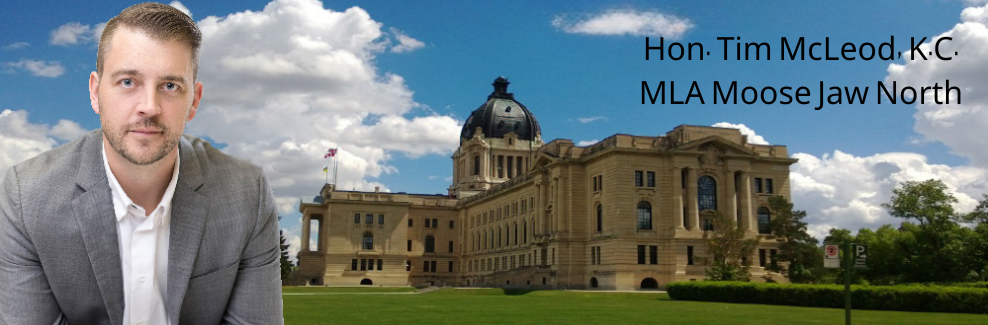
Bill 56 (The King’s Bench Amendment Act, 2026)
Second Reading
To view this section on video, click here and start play at 2:45:35 PM.
Hon. Tim McLeod: — Well thank you very much, Mr. Speaker. I am pleased to offer remarks on second reading of Bill 56, The King’s Bench Amendment Act, 2026. Mr. Speaker, the Court of King’s Bench has seen significant increases in caseload volume in recent years. This growth is an anticipated side effect of a growing population and an effective justice system.
Mr. Speaker, the primary purpose of this bill is to support the growth and efficacy with the creation of a new category of judges called associate judges. Associate judges are provincially appointed judges to the Court of King’s Bench that will be responsible for certain civil and family law matters. They will complement the work of the federally appointed judges with the goal of improving case flow and court efficiency.
This bill establishes the jurisdiction of associate judges and sets out the processes for their appointment, compensation, and oversight. The Chief Justice of the Court of King’s Bench will direct the sitting locations and duties of the associate judges, allowing the court to allocate its resources where they are most needed.
Mr. Speaker, the secondary purpose of this bill is an amendment to the regulatory powers and provisions to allow for the designation of beneficiaries under registered plans that are not included in The King’s Bench Act. This will address a legislative gap that exists when new registered plans are created.
Mr. Speaker, this bill was developed in consultation with the Court of King’s Bench, and we thank them sincerely for their time, their expertise, and their collaboration. This bill will support the government’s budget commitment to appoint four new associate judges to the Court of King’s Bench in Saskatchewan.
Mr. Speaker, I am pleased to move second reading of The King’s Bench Amendment Act, 2026, bilingual.
Standing Committee on Intergovernmental Affairs and Justice
From Hansard (5 May 2026)
To view this section on video, click here and start play at 3:59:55 PM.
Chair B. McLeod: — So today we will be considering three bills. We will first consider Bill No. 56, The King’s Bench Amendment Act, 2026, a bilingual bill, beginning with consideration of clause 1, short title.
Now Minister McLeod is here with officials. And I ask that officials please introduce themselves before they speak for the very first time, and please do not touch the microphones. The Hansard operator will turn them on for you when you speak. Minister, I invite you to please introduce your officials and make your opening comments.
Hon. Tim McLeod: — Well thank you very much, Mr. Chair. And good afternoon, committee. Joining me at the table today is Rory Jensen, assistant deputy minister for courts and community justice division. Also joining me at the table is Kara Moen, Crown counsel, legislative services. At the table behind us we have Maria Markatos, K.C. [King’s Counsel], and my chief of staff, Max Waldman.
Mr. Chair, I’ll offer some brief opening remarks for Bill 56, The King’s Bench Amendment Act, 2026, including an explanation of a House amendment that will be put forward.
This bill will amend The King’s Bench Act to create a new category of judges called associate judges. Associate judges are provincially appointed judges that will support the court’s work in family and civil matters. Mr. Chair, I want to be clear that associate judges will not be replacing federally appointed judges, but rather they will be an additional resource used to improve case flow and to reduce delays. Specific duties and sitting locations will be determined by the Chief Justice of the Court of King’s Bench, allowing the court to allocate resources where they are needed most.
This bill sets out a list of restrictions on associate judges’ jurisdiction, which includes criminal matters, hearing oral evidence, and injunctions. Salaries and benefits will initially be set by the Lieutenant Governor in Council, which will be followed by a compensation committee. The commission will follow the same procedure as the one used for justices of the peace. The bill establishes a review council to address allegations of misconduct or incapacity of an associate judge.
And finally the bill introduces an unrelated amendment to the regulatory powers provision to allow for the designation of beneficiaries under the registered plans that are not named in The King’s Bench Act. This will address a legislative gap that exists when new registered plans are created, such as a first home savings plan.
Mr. Chair, the government will be putting forward a House amendment to the appointment provisions found in section 3.1-2 of the bill. The amendment would restrict eligibility to individuals who have belonged to a Canadian bar for 10 years preceding their appointment. A new subsection (3) has also been added, or will also be added, to require the Chief Justice to review the applications for associate judge positions and provide recommendations to the minister regarding appointment.
This bill was a collaborative effort with the Court of King’s Bench, and we sincerely thank the court for its involvement on this project. With that, Mr. Chair, I welcome any questions respecting Bill 56, The King’s Bench Amendment Act, 2026.
Chair B. McLeod: — Thank you, Minister. I will now open the floor to questions, and I recognize MLA Sarauer.
Nicole Sarauer: — Thank you, Mr. Chair. And thank you, Minister, for your opening remarks. And I appreciate the amendments that you plan to put forward. Just to get started on this bill, could you provide the committee a background of how this conversation and legislation came to be?
Hon. Tim McLeod: — The conversation has been ongoing for a few years with the Court of King’s Bench. The Chief Justice of the court has spoken to myself and prior ministers of Justice and Attorney General about these positions being created. And so, over time and with a lot of consultation, together with the court we were able to put forward these positions in this year’s budget.
Nicole Sarauer: — And how do these associate judge positions compare to what exists in other jurisdictions?
Kara Moen: — Kara Moen, Justice and Attorney General. So there are similarities with other legislation. There are five other provinces already that have associate judges or applications judges. And our legislation, we certainly reviewed other provinces’ legislation when creating this, and so there will be the ability . . . In terms of duties, we modelled it after Manitoba and Ontario on certain restrictions that we have. But it’s the same idea that we’re empowering a new supportive tier of judges to assist the superior court.
Nicole Sarauer: — Can you explain to the committee why this is needed for King’s Bench?
Hon. Tim McLeod: — So a couple of reasons. Certainly increased workflow in the court. As you very well know, the reasons for decisions have been increasing over time, and that applies pressure to all of our judges’ time.
We currently have three vacancies on the Court of King’s Bench as well. So those judicial vacancies that are federally appointed, we’ve been lobbying the federal government for a couple of years now to make sure that we get that full complement. But not having the full complement of judges at that court has applied additional pressure.
An increasing complexity in cases, I would say, as well. Not just the volume of work, but the complexity of the cases before the court. So all of those things have added pressure to the Court of King’s Bench. In addition I would say that the volume of work is largely a result as well of just a growing province. We have more population than we had 10 years ago, and I think that’s another factor. All of those factors combined have really created a need that this particular position is well suited to address.
Nicole Sarauer: — As you mentioned, you’ve been lobbying with the federal government to have those vacancies filled. Any insight as to why they seem to be delayed, the federal government, in filling these positions?
Hon. Tim McLeod: — Well we don’t have any clear answer. We know that we’re not alone in that. All of the provinces — I will say almost all; I think it’s all, but if not, almost all — have vacancies at their superior court level. So I know the federal government is hearing from all of the provincial governments about this concern. But we, for the interests of Saskatchewan, are certainly pressing as hard as we can to make sure that we get the full complement of judges because, quite frankly, I’m of the view that a full complement, if not an expanded complement, is appropriate for our province.
Nicole Sarauer: — Have you been advocating with the federal government for more seats at the King’s Bench level as well?
Hon. Tim McLeod: — Yeah, that’s what I meant by an expanded complement. Yeah, so the first order of business would be to fill the seats that we have, but requests for an expanded complement are also appropriate. Do you have something you wanted to add?
Rory Jensen: — Rory Jensen, assistant deputy minister, courts and community justice. For the last number of years the Chief Justice for the Court of King’s Bench, with the support of the minister, has been requesting between two and four additional judges for the superior court.
Nicole Sarauer: — Thank you. Let’s talk about the work that the associate judges will be doing. I understand — correct me if I’m wrong — that that will be largely decided by the Chief Justice, but there are some restrictions in the legislation. Can you speak a bit about the work that they will be doing and why the restrictions were deemed necessary?
Hon. Tim McLeod: — Sure. So you’re exactly right. The Chief Justice will be responsible for assigning the associate judges, both in their location and in the nature of their duties. I think it’s important to note that the associate judges will have the same jurisdiction as judges of the court; however there will be some exceptions.
Applications to set aside, vary, or amend an order of a judge would be outside the jurisdiction of an associate judge; applications to abridge or extend a time in an order that an associate judge could not have made; contentious questions of fact, unless decided in chambers on affidavit evidence; criminal proceedings; applications relating to civil contempt or an injunction, judgment or order in the nature of certiorari prohibition, mandamus, or quo warranto; or anything that constitutionally must be done by a superior court judge.
Nicole Sarauer: — Let’s talk a bit about how the appointment process will work. You’ve mentioned that an amendment is coming forward that will clarify that the Chief Justice will make a recommendation to the minister.
Could you explain why the choice was made to not use — and I forget the formal term of the judicial committee that appoints or makes recommendations to the minister for Provincial Court appointments — can you explain why that process was not chosen for this process?
Hon. Tim McLeod: — Yeah, a couple of reasons, I would say. First of all, I think it’s important to remember we’re talking about four positions. And once these positions are appointed, they’re typically held until an individual retires or they reach the age of 70. So there’s not going to be a lot of them. And in consultation with the Chief Justice it was determined that the process that we’ve arrived at is preferred.
And certainly we can evaluate. If these positions grow and expand, and there’s a lot more of them, if there’s a need to stand up an entire council, that’s something that we could look at later. But for the time being, with the number of positions, the nature of work, and the process that we’ve arrived at in consultation with the Chief Justice, this was deemed to be the appropriate path.
Nicole Sarauer: — And what will the application process look like for somebody who has interest in this position?
Rory Jensen: — So the positions will be publicly advertised. The ministry will support the Court of King’s Bench in the administrative functions we’re gathering, posting job advertisements on various sources. The critical one will be with the Law Society website.
And we will help support gathering to share the applications with the Chief Justice for review and also support kind of the general administrative functions. The screening and interview process will be with the court, as they will know . . . have the best set for what the requirements would be. But the ministry will provide kind of that support function to publicly advertise these positions and gather the applications.
Nicole Sarauer: — Yes, thank you. Let’s lastly speak a bit about the remuneration for these positions. I understand, I think you said that they will be initially set by the ministry, but there will be a committee that will make a determination. Just could you speak a little bit about what the salary will be at the start? And then the process for what it will look like moving forward.
Hon. Tim McLeod: — Sure. So the annual salary at first instance will be aligned with justices of the peace at approximately $195,000. Compensation for associate judges can initially be determined by the Lieutenant Governor in Council, but a compensation committee will ultimately be stood up to evaluate the salaries on an ongoing basis.
Nicole Sarauer: — How long will it take for the compensation committee to be established and their recommendation made on that salary?
Rory Jensen: — So in the legislation we have determined that the initial compensation commission will need to take place within nine months of the coming into force on the Act. After that it will be aligned with how the Provincial Court judges’ and the justices of the peace’s compensation cycle is, which is every four years after that.
Nicole Sarauer: — Other jurisdictions that have similar positions tie these types of judges’ remuneration to Provincial Court judges. Is that the intent of the ministry?
Rory Jensen: — Well the Justice of the Peace compensation, which these positions will be aligned with, is tied to provincial, is 51 per cent of the Provincial Court judges’ salary. That’s what the initial set rate will be. So then the rest will be left up to the determination of a compensation commission.
Hon. Tim McLeod: — If I could add to that point. One of the factors that, as Rory mentioned, that will be evaluated over that nine months is specifically tied to the nature of work that these individuals are assigned by the Chief Justice. So at the outset we anticipate that it will align most closely with the Justice of the Peace, which is why that’s where the salary is being initially set.
[16:15]
But what’s ultimately put forward as a submission or an expectation from the compensation commission, what that commission will be considering is the nature of the work largely that we don’t yet know because the Chief Justice hasn’t assigned it.
Nicole Sarauer: — Now my understanding, and correct me if I’m wrong, is that other jurisdictions tie it much closer to a Provincial Court judge’s salary. So it’s significantly higher than what would be this current rate or 50, 51 per cent. Sorry, I forget what the percentage was, but near 50 per cent of what the Provincial Court judge’s salary is. It’s much closer to being comparative to a Provincial Court judge’s salary.
And I only express this in the assurance that you’re able to get folks apply for these important jobs. And you and I both know that getting people to apply to the bench is always something that the ministry is advocating for. So is the intention of the ministry to, and I understand that there will be a committee process, but to more closely align it so it’s commensurate with what a Provincial Court judge makes?
Hon. Tim McLeod: — I would say that the intention is to most closely align it with what’s commensurate with the nature of work that’s assigned. We can’t know at this point in time what this type of position in another province, the nature of the work that they’re doing compared to what the nature of the work that these individuals will be doing. That will be something for the compensation committee to evaluate.
Nicole Sarauer: — Thank you. And can you explain for the committee’s understanding what the complaints process will look like for associate judges? I know that’s in the legislation.
Kara Moen: — The Act will establish an associate judges review council composed of the Chief Justice of the Court of King’s Bench, a judge appointed by the Chief Justice, and a person appointed by the Lieutenant Governor in Council. The procedures of the review council will mirror those in The Provincial Court Act, 1998. The council’s responsible for receiving, investigating, and making determinations on allegations of judicial misconduct and incapacity.
The chairperson would do an initial investigation, and they can dismiss the complaint or refer it to council for further review. And a hearing committee consisting of a judge, Provincial Court judge, and lawyer would be struck to generate a report which would then be provided to council to make a determination.
Nicole Sarauer: — Thank you. And what other access-to-justice measures are the ministry looking at to address access to court time issues?
Hon. Tim McLeod: — Thanks for the question. So obviously these four positions are directly related to access to justice. We also in this year’s budget added six more Justice of the Peace positions. We’ve added three Provincial Court judge positions, expanding the complement of Provincial Court judges.
And we also have now stood up the two bylaw court hubs and traffic safety courts to alleviate some of the pressures that we’re seeing in our more heavily populated areas, granting greater access to justice for the rural communities that are using those.
Nicole Sarauer: — Thank you. No further questions.
Chair B. McLeod: — Seeing no more questions, we will proceed to vote on the clauses. And as you know, it is a bilingual bill so it’ll take a little longer, but we’ll get through it.
Clause 1, short title, is that agreed?
Some Hon. Members: — Agreed.
Chair B. McLeod: — Carried.
[Clause 1 agreed to.]
[Clauses 2 to 4 inclusive agreed to.]
Clause 5
Chair B. McLeod: — Clause 5. I recognize MLA Martens.
Hon. Jamie Martens: — Thank you, Mr. Chair. I’d like to move an amendment, please, to:
Clause 5 of the printed Bill
Amend section 3.1-2, as being enacted by Clause 5 of the printed Bill, by striking out subsection (2) and substituting the following:
“(2) No person is eligible to be appointed as an associate judge unless the person is a member in good standing of the bar of one of the provinces or territories of Canada and has been such a member for at least 10 years immediately preceding the day on which the person is appointed.
“(3) The chief justice shall:
(a) review applications for the position of associate judge; and
(b) make recommendations to the minister regarding proposed appointments to the position of associate judge”.
Chair B. McLeod: — MLA Martens has moved an amendment to clause 5. Would any members like to speak to the amendment? Do committee members agree with the amendment as read?
Some Hon. Members: — Agreed.
Chair B. McLeod: — Carried. Is clause 5 as amended agreed?
Some Hon. Members: — Agreed.
Chair B. McLeod: — Carried.
[Clause 5 as amended agreed to.]
[Clauses 6 and 7 agreed to.]
Chair B. McLeod: — His Majesty, by and with the advice and consent of the Legislative Assembly of Saskatchewan, enacts as follows: The King’s Bench Amendment Act, 2026, a bilingual bill.
I would ask a member to move that we report Bill No. 56, The King’s Bench Amendment Act, 2026, a bilingual bill, with amendment. MLA Crassweller moves. Is that agreed?
Some Hon. Members: — Agreed.
Chair B. McLeod: — Carried. So thank you for the process that we’ve just gone through, Minister and your officials. Appreciate it so much. I always learn quite a bit regarding legal matters when we have those conversations, so I appreciate that. Any closing comments, Minister?
Hon. Tim McLeod: — Just briefly, thank you, Mr. Chair. I want to thank the committee and specifically Ms. Sarauer for her questions. Thank you to my officials as always for continuing to do just wonderful work for the people of Saskatchewan and for the Ministry of Justice. Thank you too of course, Madam Clerk and Hansard and broadcasting services. But I would also be remiss, Mr. Speaker, if I didn’t specifically thank the Chief Justice of the Court of King’s Bench, who has been instrumental and a great partner in working together with this legislation.
Chair B. McLeod: — Any closing comments, please.
Nicole Sarauer: — Thank you, Mr. Chair. I’d just like to join with the minister in first thanking yourself and the committee for their work this afternoon. Thank the minister for answering my questions as well as his officials for all the work they do each and every day, including the minister’s chief of staff. I very much appreciate it. Thank you to Hansard and broadcast services for their work as well.
Back to 2025/2026 Session

Constituency Office
Constituency Assistant: Jacqui Stephens
200 – 99 Diefenbaker Drive
Moose Jaw, SK S6J 0C
Telephone: (306)-692-8884
Fax: (306)-693-3251
Email: mjnorthmla@sasktel.net
Hours of Operation:
Monday to Friday from 8:30 to 12:00 and 12:30 to 4:00