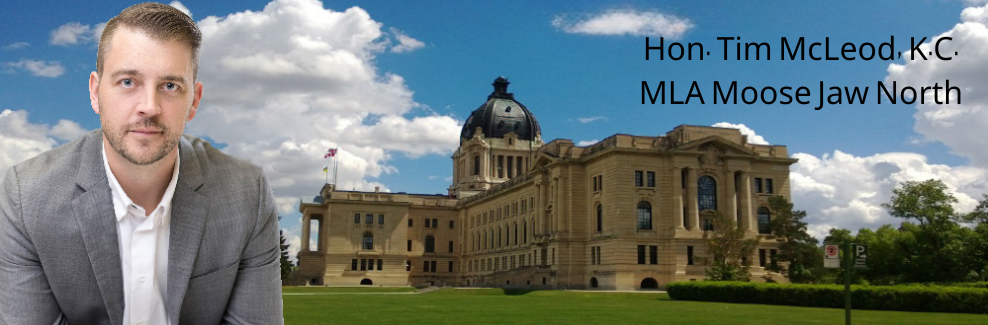
Budgetary Estimates (13 April 2026)
From Committee Hansard (13 April 2026)
To view this section on video, click here and start play at 4:09:20 PM.
Ministry of Justice and Attorney General
Chair B. McLeod: — We will begin with vote 3, Justice and Attorney General, central management and services, subvote (JU01). Now Minister McLeod is here with his officials. There are new officials, so I’ll ask again not to touch the mikes and to identify yourselves the first time you speak. And you can go ahead please, Minister. Make your opening comments and recognize those sitting with you, please.
Hon. Tim McLeod: — Well thank you very much, Mr. Chair. I am pleased to provide the highlights of the Ministry of Justice and Attorney General’s 2026-27 budget and financial plan and to answer any questions of the committee.
The Ministry of Justice and Attorney General’s budget exemplifies our commitment to a fair and accessible justice system that protects the rights of all individuals, strengthens public safety, holds offenders accountable, and supports the well-being of families and communities right across our province.
The courts and the provincial justice system are fundamental pillars of our province, and ministry staff work every day to ensure these systems serve the best interests of Saskatchewan people. Through the ’26-27 budget we are protecting and strengthening these foundations, making sure Saskatchewan’s justice system is equipped to serve a growing province.
This work directly supports the Saskatchewan growth plan. While growth brings new opportunities, we are also seeing rising caseloads, more complex family matters, and increased demands upon our justice system. Our budget addresses this through strategic investments to strengthen capacity in the justice system by adding new judges and hiring additional prosecutors to prosecute complex provincial immigration and taxation offences.
The Ministry of Justice and Attorney General provides critical services to protect the vulnerable within our society, including victims and survivors of interpersonal violence and abuse; families that need support as a result of separation, divorce, or other difficulties; and those who cannot independently manage their own financial affairs. We also provide citizens with services they can use to settle disputes, such as those offered by the Office of Residential Tenancies or the dispute resolution office. And we ensure citizens have representation in the justice system through agencies such as the Public Complaints Commission, the serious incident response team, and the Highway Traffic Board.
Before we get into specifics of the ministry’s budget, I will introduce officials who are joining us here today. Mr. Chair, seated with me are, to my left, the deputy minister of Justice, Kimberly Kratzig; and to my right, Deputy Attorney General Max Bilson, K.C.
Also joining us in the room today . . . And I will apologize in advance if I miss anyone. We do have quite the team here today and I’m grateful for every one of them. We have assistant deputy attorney general of justice services and tribunals, Kylie Head, K.C.; assistant deputy attorney general of public prosecutions, Elizabeth Hilts, K.C.; assistant deputy minister of courts and community justice, Rory Jensen; assistant deputy minister of corporate services, Brad Gurash; Chief Coroner of Saskatchewan, Jeffrey Wagner; executive director of legal services, Darcy McGovern, K.C.; executive director of community safety and well-being, Gina Alexander; executive director of financial services, Cindy Hingley; and chief executive officer of Legal Aid Saskatchewan, Jayne Mallin.
Also joining us we have Saskatchewan’s firearms commissioner, Blaine Beaven; deputy commissioner and Chief Firearms Officer, Murray Cowan; executive director, corporate services, Dan Dierker; executive advisor to the commissioner, Stephen Coote. We have chief executive officer of the Financial and Consumer Affairs Authority, Roger Sobotkiewicz. And I will ask any officials who join us at the table to introduce themselves first before they respond to any questions.
The overview of the budget, Mr. Chair, is as follows. This budget aligns with our ongoing work to protect Saskatchewan communities. In total we are investing nearly $269 million to operate the justice system for Saskatchewan residents. This budget maintains our commitment to a fair, accessible justice system that protects Saskatchewan families, communities, and the provincial economy.
To ensure we are getting the most out of our budget this year, we made target investments in increasing capacity within the justice system, continuing our work to modernize Saskatchewan courts, enhancing the Office of the Public Guardian and Trustee as well as the Highway Traffic Board, making the Saskatchewan child protective service permanent, advancing interpersonal violence programs and services, providing a financial lift to our community-based partner organizations, and increasing funding for the Saskatchewan Human Rights Commission. I will briefly provide more specifics on each of these categories before we move on to questions.
Starting with increasing capacity within our justice system. As our population grows, the need for justice services grows right along with it. In recent years we have seen an increased need for the judicial positions to handle increasing caseloads in both the Provincial Court and the Court of King’s Bench. To ensure that our courts continue to operate smoothly, we will be investing $1.97 million to add capacity to our judiciary. This will include the addition of three new judges to the Provincial Court who will be appointed later this year. The addition of these judges will increase the capacity of the Provincial Court and ensure cases are resolved in a fair, just, and timely fashion.
[16:15]
Similarly we will be appointing four new associate judges to the Court of King’s Bench. These positions will also be appointed later this year to take on routine procedural matters currently being handled by Court of King’s Bench justices. This will balance the judicial workload, improve scheduling flexibility, and support faster resolution of cases. We will also be hiring six new justices of the peace to provide independent adjudication of major inmate discipline hearings in Saskatchewan correctional centres. This is in accordance with the recent decision by the Supreme Court of Canada.
This year’s budget also includes a targeted investment of $400,000 in our public prosecutions division to hire two Crown prosecutors, who will specialize in prosecuting complex provincial immigration and taxation offences. These positions will protect the economic integrity of our province, improve enforcement and compliance with provincial legislation, and support public safety.
Next I’ll speak to the court modernization. As we increase capacity in the judiciary and prosecutions, we must also ensure that court infrastructure keeps pace with the ongoing evolution of the justice system and the modern expectations of our population. To ensure Saskatchewan’s courts remain safe and accessible, we are dedicating $3 million to fund essential repairs, safety upgrades, detention improvements, and overall courthouse functionality across Saskatchewan. This funding is essential to address rising caseloads, the growing volume of remote appearances, and the increasing strain of completing jury trials, which are becoming more complex within the timelines mandated by the Supreme Court of Canada under the Jordan decision.
Specific initiatives being pursued this year include the ongoing implementation of electronic filing and the public-facing portal through the J-STAR [judicial scheduling, tracking and amalgamated reporting] system, necessary IT [information technology] upgrades for the judiciary, and planning for a provincial court scheduling system. Additional infrastructure improvements being made this year include detention area upgrades, distress button systems, and accessibility enhancements.
Next to address the Public Guardian and Trustee and the Highway Traffic Board investments. In addition to adding core justice system personnel and improving courthouse infrastructure, we are also making investments in critical services provided through those two agencies. The Highway Traffic Board, which is responsible for hearing appeals to SGI [Saskatchewan Government Insurance] and regulating transportation safety on Saskatchewan roads, will receive approximately $1.315 million in new capital funding to build a new IT portal to replace manual processes and provide citizens with secure user-friendly online access. This new system will be implemented over a period of two years, with the cost being split between the Ministry of Justice and Attorney General and SGI.
The Office of the Public Guardian and Trustee will also see its funding increase this year by $326,000, which will be used to add four new positions. Once in place, these staff will be responsible for protecting the financial resources of vulnerable children and adults as well as the estates of deceased persons. The work of the Public Guardian and Trustee is essential for individuals who are unable to manage their own financial affairs and do not have a trusted family member or guardian to otherwise act on their behalf.
Turning now to the child support calculation service. Since it was established in 2018, the child support calculation service has provided parents with an effective, more user-friendly alternative than going to court to get clarity around child support payments. In 2023 this program was expanded to allow parents to calculate initial child support payments without having to go to court at all. In addition to providing a more efficient and cost-effective option for parents, the child support calculation service also lowers conflict levels and provides families with critical support and resources during what can often be a very challenging time.
While this program started as a pilot project in partnership with the federal government, this year we will be transitioning the service to a fully provincially funded model through an investment of $170,000. While most provinces and territories have a recalculation service, Saskatchewan is only the third province to develop the additional calculation service. We are proud to be able to transition this important program to a fully provincially funded model, ensuring that it will be available to Saskatchewan parents and children on a permanent, ongoing basis.
Next to speak to interpersonal violence programs, supports, and tools, Mr. Chair. Our government has a strong track record of providing support for individuals who are affected by interpersonal violence. Issues such as domestic violence, sexual assault, and human trafficking are an ongoing concern across Canada, and certainly Saskatchewan is no exception.
This year we will be investing approximately $33.5 million through the justice system to maintain interpersonal violence programs, services, and tools in Saskatchewan and to explore innovative ways to further address this complex issue. This amount includes funding provided through the ministries of Justice and Attorney General and Community Safety as well as approximately $5.7 million from the federal national action plan to end gender-based violence.
A significant amount of this money is provided to community agencies to provide targeted services to reduce the impact of victimization, the likelihood of re-victimization, and the number of interpersonal violence and abuse incidents overall.
The agencies we partner with provide a wide spectrum of programming for survivors of abuse, including transition houses, second-stage housing, sexual violence services, and transportation.
This funding also includes investments to programs and tools designed to address interpersonal violence before it starts, such as family violence intervention programming, family intervention rapid support teams, and education and awareness programs and campaigns.
Turning now to the CBO [community-based organization] lift, to help our community-based partners continue to provide these vital programs and services, the ministry’s ’26-27 budget includes an increase of $440,000 or 2 per cent for community-based organizations that are funded by the ministry.
The majority of this funding, 412,000 to be exact, will be dedicated to organizations that work to address the impact of interpersonal violence and abuse. The remaining $28,000 is shared by community partners who support the delivery of the Aboriginal court worker program and the Federation of Sovereign Indigenous Nations special investigations unit.
We value the work of all of our community-based organizations and stakeholders, and we look forward to continuing our important work with them in the year ahead.
The Saskatchewan Human Rights Commission. Saskatchewan has a strong record of protecting and supporting human rights through our ongoing commitment to human rights legislation and our continued support of the Saskatchewan Human Rights Commission. The commission protects and promotes human rights and advances equality for all Saskatchewan people, and provides a free complaint process for everyone to access to bring forward their concerns about discrimination or human rights offences.
As Saskatchewan’s population grows and becomes more diverse, the demand for human rights education, outreach, and complaint resolution will continue to increase along with it. To prepare for this and ensure the commission can continue its ongoing mission to protect the rights of Saskatchewan people, we will be providing $500,000 in new operating funding.
Additionally this year’s budget includes $1.5 million in one-time capital funding to relocate the commission’s office to a new building, which will address space issues and allow them to better serve the needs of the public.
In closing, the Ministry of Justice and Attorney General is well positioned to meet its goals and mandate in 2026-27. We look forward to continuing our work with the courts, our community partners, other ministries, and to protect the public access to the justice services, promoting accountability and increasing public safety across our province.
The funding for the 2026-27 fiscal year will ensure that Saskatchewan continues to have a fair, accessible, and equitable justice system. I would now be pleased to answer any questions about the budget and the business plan for the Ministry of Justice and Attorney General. Thank you, Mr. Chair.
Chair B. McLeod: — Thank you, Minister. I will now open the floor to questions. And I recognize MLA Sarauer.
Nicole Sarauer: — Thank you, Mr. Chair, and thank you, Minister, for your opening comments. I just want to start — before I go into questions about the various announcements that you have made in your discussions and your opening remarks — with an overall question regarding the budget of Justice and Attorney General. You’ve mentioned some new programs and some new investments that are happening; however the estimated budget is a reduction from ’25-26. So can you please explain what has either been cut or reduced in terms of funding from your ministry this budget year?
Hon. Tim McLeod: — Thank you for the question, and I’m going to speak to kind of a high-level answer to the question, and then I’ll let Deputy Minister Kimberly Kratzig get into a little more detail.
But to address the concern, there haven’t been services cut from the budget. What actually happened was $6.6 million of our previous budget was transferred for enterprise IT costs to the Ministry of SaskBuilds and Procurement. A budget item was moved to a different ministry, which shows a corresponding reduction in the overall budget, but it wasn’t a cut of services. It was simply a transfer of those IT services being moved to the Ministry of SaskBuilds and Procurement. And that was the primary reduction.
There was also a $1.4 million decrease in non-statutory salaries as part of the workforce realignment, but no job losses. No individuals lost their job as a result of that. But I’ll let Deputy Minister Kratzig get into more detail about that.
Kimberly Kratzig: — Thank you. I think that, you know, the minister really did summarize. In addition to all of the investments that the minister spoke about in his opening remarks, those were the two primary reductions that we talked about. There’s a few other sort of what I would call ins and outs of monies that we could walk through for you if you’re interested in knowing exactly what came in and out of the budget.
Would you like that level of detail? They’re lower amounts, and again they don’t . . . There’s no service reductions or anything associated with them. But I could do that if you’re interested or you have some questions about these larger ones.
Nicole Sarauer: — Do any of them involve staff reductions?
Kimberly Kratzig: — No. There’s no staff reductions. We did have three FTEs [full-time equivalent] that did move to the Ministry of Community Safety, and that was just more of the rebasing of the work that sort of happened around some changes that were made a couple of years ago. So that was done.
And as the minister said, the workforce realignment that we’ve discussed, that is being done without any impacts on individuals. That is being done through attrition as we look at efficiencies. As people are leaving the ministry, we’ll be reviewing each position to meet that target.
Nicole Sarauer: — Tell me a little bit more about the workforce realignment, where you’re hoping to find those efficiencies.
Kimberly Kratzig: — Thank you. So in terms of where we’re hoping to find the efficiencies, I think that we’re looking really throughout the entire ministry. We know that the province has instructed that there will not be an impact on front-line services, so that’s certainly a lens as we’re making decisions around the positions that we will be reducing.
We’ll be looking for efficiencies throughout all areas of the ministry though. And all positions that are being staffed will be sort of coming through our senior team, and we’ll be looking at them and having discussions with our various levels of the organization to determine, you know, what the impact is. Can we do things differently? So we’re very confident we will be able to meet the reduction target without any impact on front-line services.
Nicole Sarauer: — Do you have an estimate of how many FTEs $1.4 million in reductions will mean?
[16:30]
Kimberly Kratzig: — For our ministry, our reduction target is 44.5 FTEs over two years. So we have about 1,145 positions, so we feel that we’ll be able to again really do that in a responsible way that will not impact front-line services as individuals are leaving our workforce, whether it be moving to other places, retiring, whatever that might be. We’ll be assessing which of those positions could form this target over two years.
Nicole Sarauer: — Can you explain this $6.6 million that was transferred to SaskBuilds and Procurement?
Kimberly Kratzig: — Sure. So the $6.6 million reduction that’s being transferred to SaskBuilds and Procurement is an across-government change to the funding model for IT. There’s no change to the services that are being provided. But SaskBuilds and Procurement provides a range of services to all ministries, so they’ve changed the funding model. So instead of billing us for those services, we’ve given back the money — in our case, $6.6 million. Examples of that might be things like IT security charges or service desk, that type of thing that’s done across all ministries.
Nicole Sarauer: — Thank you. Now, Minister, you’ve discussed that there will be the appointing of four new associate judges, three new Provincial Court judges, and six new justices of the peace. Which line item of the budget would their expenses be coming out of, just so that I can see it in the Estimates?
Hon. Tim McLeod: — Looking at page 88 of the Estimates under courts and civil justice, (JU03), the allocations are all broken down there: salaries for Provincial Court judges; salaries for King’s Bench associate judges; salaries for justices of the peace; as well as family justice services; dispute resolution; and court facility land, buildings, and improvements.
Nicole Sarauer: — Thank you. You have $390,000 allocated for the new associate judge positions. Could you explain to the committee how much each associate judge is going to be paid?
Hon. Tim McLeod: — So the initial compensation will be aligned with the compensation framework for justices of the peace, reflecting a similar supportive judicial function performed by associate judges. Their work to a King’s Bench justice will be comparable to what a Justice of the Peace work for a Provincial Court judge will be.
In terms of their specific compensation, their duties as assigned, we’re still in conversation with the Chief Justice of the Court of King’s Bench to align the appropriate work for these positions. And that in turn will ultimately impact the compensation. But generally speaking the compensation will align with the same framework that we use for justices of the peace at the Provincial Court level.
Nicole Sarauer: — So when you say it’ll be the same framework, will they be paid the same as a Justice of the Peace? Or has that not been ironed out yet because the scope of the duties hasn’t been ironed out quite yet?
Hon. Tim McLeod: — I guess what I can say is that the $390,000 that’s listed in the estimates is built around a mid-year start and based upon a Justice of the Peace salary. The specifics of the pay structure and the details around these positions will of course appear in the legislation that hasn’t yet been tabled but will be tabled shortly.
Nicole Sarauer: — Are you able to provide the committee any information as to how these associate judges will be appointed? What will the process be?
Hon. Tim McLeod: — I would say, similarly, the appointment process will be better articulated in the legislation, and I’m keen to avoid speaking too detailed about legislation that isn’t yet on the table. However we can say that they would be appointed through a similar process using an order in council and again in close consultation with the Chief Justice of the court.
Nicole Sarauer: — Do you know yet where these associate judges will be located in the province?
Hon. Tim McLeod: — The location of the specific positions is ultimately a determination made by the Chief Justice. However I can anticipate that, given that the nature of these positions is to support some of our busiest court points. Saskatoon and Regina tend to be the heaviest load for family services and the civil matters that are likely to be addressed most directly by these new positions.
Nicole Sarauer: — Thank you. Will there be any other additional supports provided to the courts for these associate judges? I’m thinking clerks, office space, that sort of thing. And if so, how much has been budgeted for that?
Rory Jensen: — Rory Jensen, assistant deputy minister, courts and community justice. Thank you for the question.
In this budget we did not include additional amounts as we believe that the infrastructure and support staff can be absorbed in the existing complement. We believe that we have office space for the additional associate judges and existing staff in the courthouses that we can provide the support.
Nicole Sarauer: — One of the challenges I hear with respect to pressure is related to court time, access to court facilities. Do you feel like this will help address those concerns? And how?
Hon. Tim McLeod: — The creation of these positions is largely to alleviate some of the pressure that we’re seeing on our King’s Bench judges, taking away some of the routine matters, some of the Chamber’s matters off of their plate to allow them to focus their attention on the more complex matters, giving them more time to write their decisions on those complex matters, which of course more and more detail is being included in those decisions.
The access-to-court time, we are largely hearing, is more of an issue at the Provincial Court level which is why we’ve established the bylaw and traffic courts in Rosthern and Fort Qu’Appelle. Again pulling some of the matters out of the busier court points like Saskatoon and Regina, allowing those municipalities for their bylaw matters and their traffic matters to be heard in a different court point; pulling those out of the busier courtrooms, again creating the space and availability of the courtrooms in the Provincial Court.
These associate judge positions are really about alleviating more of the work off of the workload of the King’s Bench justices.
Nicole Sarauer: — Thank you. On the Provincial Court you had mentioned that there will be an appointment of three new Provincial Court judges. Can you indicate where they will be located?
Hon. Tim McLeod: — Similarly, ultimately the location of those appointments will be at the discretion of the Chief Judge of the Provincial Court. However we would anticipate again that they will be targeted to alleviate the pressures in the busier court points.
Nicole Sarauer: — Similarly will there be the addition of the hiring of any clerks? Is there any firm or office space? Any of that additional expense, has that been contemplated this budget cycle? And if so, how much?
[16:45]
Rory Jensen: — So similar to associate judges, we do believe that within the existing budget allotment we do have, we can absorb any additional infrastructure or staff needs to support the appointment of the new judges for Provincial Court. In the existing budget appropriation we have just over $1.2 million for capital work within courthouses across the province.
So when we’re evaluating how that money will be distributed, we meet with all three levels of court to determine their prioritization of their needs and what they would like to see addressed. So this is a really collaborative conversation between the ministry and the levels of court.
In conversations that we’ve had recently with Chief Judge Metivier since the budget, she has indicated that she would like to earmark some of that money to ensure that we can develop any judicial officers in courthouses to make sure that we have appropriate officers for new appointments as well as meet the needs of the judiciary going forward as we implement and make new appointments.
Nicole Sarauer: — Thank you. As has been mentioned, there is a significant challenge in terms of pressures of the court at the provincial level. Obviously the appointment of these three new judges is reflective of that. Similar to what I asked at the King’s Bench level, there is no increase in court facility space, but can you explain whether or not this will help deal with the pressures around court facility access right now that is being felt in the justice system?
Rory Jensen: — Thank you for the question. The three additional judges will help increase access for communities to courts. One of the benefits of having these new judicial appointments: the court will become less reliant on relief judges who, as you may be aware, are retired judges that really will determine when they would like to work. By having full-time appointments, they will be better able for scheduling to ensure resources are available for less cancellations of court.
Other things that we’re also working on: as the minister mentioned, the bylaw hubs that are being implemented will be overheard by a senior Justice of the Peace. These will expand the availability of communities to access the court system instead of having their bylaw matters grouped in with a general docket. They will have dedicated time. By separating these out, we also free up judicial resources for judges to focus on the more complex cases and allow senior justices of the peace to do their work and oversee bylaw matters.
We’re also continuing to focus and invest in video appearances in court. So right now approximately 30 per cent of all appearances in court are heard by video or virtual matters. We’re also working closely with Provincial Court and Court of King’s Bench on making sure that virtual appearance has gone streamlined and efficiently, so when the judiciary and court is expecting a person to appear, that they will appear and also that those options are available to citizens to have their matters heard through virtual options.
By doing this, we’re really going to be serving citizens to meet them where their needs are. We’re also going to be . . . One of the benefits of this is also really creating more, increasing community safety. Because as we can have increased virtual appearances, we’re less reliant on prisoner transport to bring in-person matters. So there’s more policing, and RCMP [Royal Canadian Mounted Police] are able to focus on front-line policing work instead of supporting bringing prisoners to court.
And also by adding additional judicial resources, similar to the associate judges for King’s Bench, it will allow . . . By having additional judicial resources, there will be more time for the judges to write decisions, while we still maintain making sure that courtrooms . . . we’re maximizing and using space efficiently to make sure that matters continue to be heard and their decisions are completed in a very timely manner.
Nicole Sarauer: — Thank you. Now you’ve mentioned that there will be the hiring of two new Crown prosecutors to focus on immigration and taxation matters. Can you explain to the committee why this was seen as a targeted need?
Max Bilson: — Thank you. Max Bilson, deputy attorney general. At a very broad, high level and broad strokes, the positions are necessary to assist with the enforcement of laws in Saskatchewan to ensure the integrity of our immigration system in the province and in the country. And also on the taxation side to ensure the integrity of the tax system and the collection of tax and the fairness of tax for people of the province.
And I think my colleague Elizabeth Hilts can speak to the details of the actual prosecution.
Elizabeth Hilts: — Sure, thank you. Elizabeth Hilts, assistant deputy attorney general, public prosecutions. So we made the request for these two prosecutors just because of the very specialized nature of the work. The provincial legislation as it relates to immigration and as it relates to provincial taxes is not something that we would deal with on a regular, day-to-day basis. And tax law can have a lot of ins and outs. And so we think it’s important for proper prosecutions that we have people in place who can become specialists in that particular area of tax work. And the same is really the case for the immigration work.
The integrity of that legislation obviously depends on people having confidence on where there are people who are not following it, that they will be held accountable, and for us to have prosecutors that are able to take the cases to court to ensure that people are held properly accountable.
Nicole Sarauer: — Now please correct me if I’m wrong, but when I look at the line item for public prosecutions in the Estimates document, it’s actually a slight decrease from last year. So can you explain how you’re hiring two new prosecutors, yet the budget appears to be decreasing?
Kimberly Kratzig: — I can explain that, sure. So we are hiring two new prosecutors. It is a $400,000 investment. We also do have a decrease in the budget line. What we did when we received the workforce alignment target that we talked about earlier — the $1.4 million — we allocated it across all votes in the Ministry of Justice. They will not turn out that way, and if you actually look you’ll see some very small reductions across different areas of the Ministry of Justice.
We don’t know where people will be leaving from. We don’t know if those are positions that will be replaced or not. So we had to allocate the money in a fair way, so that’s what you’ll see across the entire budget.
[17:00]
And as the year goes on, we of course have the ability to move the money back and forth. So the percentage of workforce reduction target in prosecutions, that’s the decrease that you’re seeing.
Nicole Sarauer: — So I hear what you’re saying is that there hasn’t been a decrease in the level of prosecutors at this time, but there is the possibility that there will be a reduction in prosecutors in the next two years.
Kimberly Kratzig: — I think how I would answer that is similar to how I answered it earlier. We will be looking at every position. We will be doing everything we can to not impact front-line services and services that are in high demand and high need. And as you see, we’ve made the investment of two new FTEs; government has decided this is a priority. So when you see the reduction in the budget in prosecutions, I would call that a placeholder, and you’ll see that throughout our budget. Those are just where the reductions were applied on very much a pro-rated basis based on the budget of each area. So that was a decision that was made internally.
We had to park, if you will, the 1.4 million, and that’s how we did it. But there has been no reduction in the number of prosecutors; in fact we are increasing the number of prosecutors.
Nicole Sarauer: — You’ve indicated that there will be continued investment of the J-STAR program as well as some courthouse improvements. Can you provide some details as to what those courthouse improvements look like and where we’re at with the J-STAR program?
Hon. Tim McLeod: — So I’ll start, and then I’ll pass things over to Rory Jensen.
Essentially the budget is providing a little over $1.2 million in ongoing court-maintenance-based capital to support essential repairs, safety upgrades, detention improvements, and courthouse functionality. The budget also includes just shy of $1.8 million for court modernization initiatives such as courtroom technology, the J-STAR electronic filing implementation that you were asking about, judicial IT upgrades, and planning for a provincial court scheduling system and further eCourt development. This investment supports the safety, security, and technology performance in our courthouses that operate at a very high capacity and have ever-increasing caseload pressures.
I think what I’ll do is I’ll turn it over to Rory Jensen to maybe get into more specifics about each of those categories.
Rory Jensen: — Thank you, Minister. So for the J-STAR project, we’re right now in the development phase, so we’re working with the vendor on what would be determined as sprints and testing. So we’ve done a number of sprints to get certain pieces of the functionality ready, and we’ve done testing on those. We are on progress and making . . . right now on the development schedule for implementation later this year.
So that’ll be a really big milestone for the Court of King’s Bench as the public-facing portal will really modernize how the court interacts, how their case management system works, and how they interact with the public and accept electronic filing, which will be a big step forward for the court.
In terms of investments in the court, we’re making some targeted investments in La Ronge and Saskatoon as well as working with the judiciary, as I mentioned earlier, to really target those investments throughout the year. We’re talking with all courthouses and resident judges to determine what the security needs of each courthouse is to make sure that, as we use this funding, that it’s really addressing the highest priority and the highest needs where it’s going to benefit the province and the court system the most.
Nicole Sarauer: — Just to clarify, you’re saying that there is in the works an electronic filing system for King’s Bench that will be public facing and will be launching?
Rory Jensen: — Yes. So a number of years ago the Court of King’s Bench implemented what is called the J-STAR system. So that’s their case management system. Right now we are in phase 2 of that. And the big push on phase 2 is really a public-facing portal that will allow for electronic filing of documents as well as just complete case management for the judiciary to see all matters that have been filed within a case in a nice electronic system. As well as creating efficiency for when a case needs to move from one court location to another, that that file can go with it electronically instead of packing up paper files and driving them to the next community where that court matter is going to be heard.
Nicole Sarauer: — Any idea when the public-facing side of that will be available?
Rory Jensen: — For the project, we are scheduled to implement that later this fiscal year.
Nicole Sarauer: — Now I heard you say eCourt development. That brings me to my evergreen question about the e-justice project and its continual pause. Could you provide any information as to what the status of that project is?
Rory Jensen: — Thank you for the question. The provincial budget, the budget includes a focus on court modernization. So there is a lot of investments being made into IT systems throughout all levels of court. As you mentioned the eCourt system, the Court of Appeal has been using the eCourt system since 2012. We continue to invest to help them enhance and modernize their system to ensure that they are still on the leading edge of court technology in the country.
We’re making similar investments with J-STAR to bring Court of King’s Bench in Saskatchewan up to a similar level of the Court of Appeal. So J-STAR is going to be, as we mentioned, have a public-facing portal, which will be very similar to eCourt, who also accepts online filing and electronic filing. So bringing Court of King’s Bench up to speed on that as well as allowing the systems to communicate. So as files flow through between the levels of court, the citizens going through the systems have more of a seamless transition. So that’s a really positive investment.
The other investment in this budget is for Provincial Court as we look at exploring a case management system and a modern case management system for that level of court to really transform the technology used at all three levels of court.
[17:15]
We also continue to invest across all levels of court, as I mentioned earlier, in virtual court, expanding the use of video court technology to have courts run more efficiently, improve community safety.
We’re really making a lot of investments across the various courts in conjunction with all levels of courts. So we meet quarterly to determine what the courts’ priorities are and help them understand their needs in the IT sector to make sure that we’re keeping them up to speed with where changes in technology are going, where they would like to move their courts, and how they can use their courts and get the most efficient use out of technology in each level of court.
Specific for the e-justice program, the e-justice program project was made up of two different parts. There was one part related to the Financial and Consumer Affairs Authority that was implemented and is up and running. The other phase was the provincial offence phase. That project is paused, but we still maintain all of the background support, so if we do want to pick that up and implement that, we still maintain all of that infrastructure with that project.
Nicole Sarauer: — Any plan this fiscal in unpausing that project?
Rory Jensen: — We are working with all levels of courts to prioritize their needs for the use of technology.
Nicole Sarauer: — How much is budgeted on maintaining that project in this fiscal?
Rory Jensen: — The amount to maintain that system is $10,000.
Nicole Sarauer: — Last year I asked for the total to-date cost at that time of the e-justice project. I requested it. I had not received it. Does the ministry have that number today, but updated to this date? And if so, could you please provide it?
Hon. Tim McLeod: — Thanks for the question. We’ve actually had that question before. As you noted, in fact, it was one of your written questions in the fall. Question 61 was answered and tabled on November the 6th, 2025 where you asked that question. The tabled answer was that the e-justice project to date at that point was a little over $6.6 million. Of course that was as of about October of 2025, so it could be updated to current date by adding about $10,000.
Nicole Sarauer: — Thank you. It helps me to find it for next year if it’s in this Hansard. Appreciate it.
Mr. Jensen, you had mentioned a few times the bylaw and traffic safety court hub announcements that were made last year. Could you provide an update on the status of those two court hubs?
Rory Jensen: — Thank you for the question. The municipal bylaw hubs in Rosthern and Fort Qu’Appelle are up and running. We’ve been working closely with the Chief Judge, and we anticipate that in the coming months, traffic safety court will also be expanded to Rosthern and Fort Qu’Appelle.
As I mentioned, working with the Chief Judge and communities to ensure their awareness is out there, to take advantage of these additional court opportunities for communities, we do anticipate that the uptake in the utilization of these courts will increase as awareness continues to build with communities.
Nicole Sarauer: — Thanks. What does it look like for those courts in those locations operationally?
Rory Jensen: — So these bylaw courts really operate similar to any other docket. The docket is focused on bylaw matters for communities. The province is providing the Justice of the Peace that overhears that and the administrative staff for communities to ensure that the court runs efficiently.
Nicole Sarauer: — What is the current status of the Indigenous court project that will be based out of Saskatoon?
Rory Jensen: — The Provincial Court is really leading an investigation into and development of an Indigenous court pilot in Saskatoon. The initiative is designed to operate similar to existing therapeutic courts with a focus on healing-centred sentencing, Elder guidance, and really community-based supports. The work has begun. There has been consultation with communities, Elder engagement, development of some initial framework. The province is working very closely with the court to establish what that framework and how the operations of the court will look when it is ready to begin sitting.
[17:30]
Nicole Sarauer: — Is there a timeline for when it is projected it will begin sitting?
Rory Jensen: — We do not have a specific timeline right now.
Nicole Sarauer: — Thank you. Is there any budget this year for the Economic Impact Assessment Tribunal?
Kylie Head: — Thank you for the question. Oh, my name is Kylie Head, and I am assistant deputy attorney general with the Ministry of Justice, specifically responsible for justice services and tribunal division.
In the current fiscal year, the cost of operating the Economic Impact Assessment Tribunal is $44,000, which is the cost of paying the retainers for the five tribunal members who were appointed to a three-year term. The funds for that are in the justice services and tribunal division line, which is on page 89 of the Estimates book.
Nicole Sarauer: — Thank you. Is there any work planned for the tribunal this fiscal so far?
Kylie Head: — No.
Nicole Sarauer: — Thank you. It wouldn’t be Justice estimates if I didn’t ask my other evergreen question, which is the total cost to date for the ongoing litigation between UR Pride and the Government of Saskatchewan. If you could just provide that for the committee please.
Max Bilson: — Thank you. Max Bilson, deputy attorney general again. As we’ve said in previous years, it’s not our policy to waive the privilege over the amounts paid in individual ongoing litigation files. Though obviously those amounts are aggregated and in future will appear in public accounts as an aggregated amount with the amounts that are spent on civil litigation in the province and are public. But we do assert privilege over the specific amounts paid on ongoing litigation files.
Nicole Sarauer: — Thank you. And just as a reminder — I know we’ve discussed this before, but to the committee — it is a privilege that could be waived by the government. They are choosing not to waive it. Is that correct?
Hon. Tim McLeod: — It’s a matter of protecting the interests of the people of Saskatchewan in terms of the litigation itself. Disclosing the specific amounts for any individual file does potentially compromise the strength of one’s case. We’re not prepared to do that.
Nicole Sarauer: — Now as you well know, Minister, the notwithstanding clause that’s subject to litigation will sunset in 2028, at which point the government will need to make a decision whether or not they will essentially renew the clause or discontinue, which would end the litigation of course. Do you not feel that the public has a right to know how much this litigation has cost it when making the analysis as to whether or not the notwithstanding clause should be renewed?
Hon. Tim McLeod: — I would say that that question could be answered when the litigation is concluded. But on an active litigation matter, disclosing the solicitor-client fees are a matter of privilege for good reason.
Nicole Sarauer: — And also just for clarity, as has been mentioned, that the aggregated cost will be reflected in public accounts. That number is a total cost that’s paid to the third-party law firm for all legal services and not just this specific litigation; is that correct?
Hon. Tim McLeod: — Correct.
Nicole Sarauer: — Thank you. Minister, I understand there’s an ongoing gender-based violence engagement session happening right now. Can you explain how much is budgeted for this project? I believe KPMG has been contracted to do this work.
Hon. Tim McLeod: — Just for clarity, you’re talking about the development of theory of change model?
Nicole Sarauer: — I understand that there have been consultations happening throughout the province conducted by KPMG on behalf of your ministry related to gender-based violence. That’s all I know. So I’m curious to know what that project is, broadly speaking, and how much is being spent on it.
Hon. Tim McLeod: — Thank you for the clarity. We just have multiple investments in this space, on reducing gender-based violence, so we just wanted to make sure we’re talking about the same one.
Kimberly Kratzig: — Thank you for the question. I’ll start with the answer and then turn it over to Gina Alexander, our executive director from community safety and well-being branch.
[17:45]
The Ministry of Justice did a call for proposals to develop a theory of change model to help inform how we approach gender-based violence. So that is what you’re referring to. Now I’ll talk about those two stages that are happening. One is to support the service map to develop, identify, categorize all the various services that are happening in Saskatchewan related to gender-based violence. And then there’s also research that outlines the reasons behind the high rates of gender-based violence in Saskatchewan. So it’s a two-stage project. They were the successful vendor. They’ve been awarded the contract in October; it expires later this year.
I’ll turn it over to Gina to talk about why that is a priority under the national action plan, what pillar that aligns with, why we think that this was an important investment to help us really understand I think at a very basic level exactly what’s happening in the gender-based violence space, and hearing from our stakeholders to understand what they would tell us we could do to better make some progress on this very important issue.
Nicole Sarauer: — Sorry, just before Ms. Alexander speaks, can you also tell us how much the contract was for?
Kimberly Kratzig: — Yeah, it’s $258,000.
Nicole Sarauer: — Thank you.
Gina Alexander: — Gina Alexander, executive director of community safety and well-being, Ministry of Justice. So just to follow up on what the deputy minister has already talked about, we think this is important for us to map out where the services are that are currently located so that we can get a sense of what’s happening across the province. And we can get a sense of not only where in the province these services are located, but also what other measures might be implemented at a later date once we discover where those services are.
The Ministry of Justice and some other ministries have a number of services. When we engage with stakeholders, this allows us to explore services that we may not know about that are in existence, that are operating quite well, that may not be funded by the provincial government, may be funded by municipal governments, may be funded by the federal government that we may not know about. So that’s in reference to the first stage that was awarded to KPMG. So get the lay of the land. Figure out what’s out there.
And then the second phase of this particular project is to, as the deputy said, research — research that outlines the reasons behind the high rates of gender-based violence in Saskatchewan. So what’s happening out there? What’s happening on the ground that service providers, communities, partners are noticing that we can all benefit from as we figure out what we do next in terms of good practice and evidence-based practice approaches? And it will also start to confirm where things are going well and maybe where there are some gaps and how we might work to fill those gaps. And this particular item falls within the foundation pillar of the national action plan to end gender-based violence. So that’s the fit which the deputy minister referred to.
Nicole Sarauer: — Will phase 2 of this project be a report that’s made public?
Gina Alexander: — So this particular work has not been designed at this point to make its way to a public report. But like all engagements that we have on a very frequent basis with stakeholders and partners that we are connected with, sometimes several times a year, the feedback from this work and also the ongoing work from the stakeholders that we work with will continue to inform our decisions as we move forward.
Nicole Sarauer: — Will the report be shared with the stakeholders who participated?
Gina Alexander: — There may be points or summaries that might be shared with the stakeholders.
Nicole Sarauer: — And how will these recommendations differ from the recommendations made in the last two domestic violence death review reports?
Gina Alexander: — So domestic violence death review reviewed files of homicide and death from 2015 to 2020, and the focus was on, of course, the serious outcomes related to that. A number of their recommendations pay attention to and inform us to look to prevention and also intervention, but the focus is on how do we stop the level of violence that results in homicides and these types of deaths.
The focus on the domestic violence death reviews included just looking at those files by three groups of folks who are experts in domestic violence across the province. And we had a group in and representing northern Saskatchewan, a group in and representing rural Saskatchewan, and then a group in and representing urban Saskatchewan, and the focus of that was about those particular files.
Different than that, on the focus of the national action plan funding and the continued work that the ministry does in terms of a number of areas of interpersonal violence and abuse, this work that we have contracted with KPMG to do will be looking much broader than at the instances of domestic violence that have resulted in death. And part of what we will be able to do is not only take the recommendations from focusing on those files in the domestic violence death review but also the work by KPMG from the federal funding that will allow us to look more broadly than just on the more serious matters that occur in our province.
Nicole Sarauer: — Thank you. Could you speak at all to the RFP [request for proposal] process that was engaged where KPMG was awarded with this project? Are you able to provide the committee information as to how many other organizations bid on the project?
Gina Alexander: — I don’t have the level of detail which you’ve requested on this particular request for proposals. What I can offer today is that the procurement processes that we use in the community safety and well-being branch follow closely the procurement processes that are utilized by SaskBuilds. And it’s an open and transparent process. You may know this. It appears on SaskTenders so agencies and individuals can see it. They’re typically open for somewhere between a month to six weeks, maybe up until two months. I don’t know the exact time frame that this particular one was open for. I don’t recall that at this point.
And then an assessment of the submissions is done by an evaluation team, and from there a successful proponent is chosen based on a rating system that is utilized. And the rating system involves analysis around the agency’s or individual’s capacity, their efforts and experience with collaboration, their experience and knowledge and skills and abilities around the particular topic, how they’ve demonstrated in the proposal their ability to achieve the outcomes which we always have in the request for proposals and procurement processes through our branch.
Nicole Sarauer: — I’m just being cognizant of the time. I’m going to move on and ask about the experiential learning program at the College of Law that the ministry provides $100,000 for. Would you provide to the committee how many students accessed the program last year and where they were all placed?
[18:00]
Kylie Head: — Thank you for the question. For this past academic year, there were two students placed at Legal Aid. One was working in The Battlefords area office and the other was in the Prince Albert area office. Additionally students at Legal Aid were given the opportunity to work in the North for a few weeks and have that experience as well, so travelling up to northern area offices. We also had two students that were placed in the prosecutions offices, one in North Battleford and one in Meadow Lake.
Nicole Sarauer: — What are the plans for placements this upcoming fiscal?
Kylie Head: — I spoke with the dean at the College of Law, Martin Phillipson, and the associate dean there as well. And because the placements are based on student interest and what community they want to go to, we’re not able to answer that with specificity at this time.
I know they are working on getting interest in some other communities, such as Yorkton was one of the centres they mentioned to me. But we’re not able to give you a specific number until registration starts in sort of September or October.
Nicole Sarauer: — When this program was originally announced, there was a lot of conversation about . . . The minister at the time mentioned that there would be placement opportunities in the private sector as well. I’m not hearing that there were placements in the private sector last year. Can you explain what happened with those ambitions?
Kylie Head: — So our contribution towards the private sector is that we pay the main costs of administration for the overall program at the College of Law. So part of the $100,000 covers the cost of the sessional lecturers because students are required, when they do these placements, to attend a sessional lecturer class at the college, a seminar class. And so we have one that’s in the first semester and one that’s in the second semester for those students.
And we’re also paying sort of the central administration fees for getting the program up and running. There’s some evaluation costs, those sorts of things. So the money that the government is providing is sort of the backbone for the program overall.
But when the private sector wants a student to be placed in their individual firm, they would pay the costs for that student. If there was a student to go rent accommodations, etc., and live in another community, that would be up to the host who is working with them in that particular community.
Nicole Sarauer: — To your knowledge, were there any placements other than the ones that you have mentioned within the program, and if so, where?
Kylie Head: — Yes. I’m sorry, I don’t have the complete list of what happened at the College of Law, but they did talk to me about it and there were quite a number of different placements. Some of the ones that I remember were the administration office right on the campus at the College of Law. I think there was like some mining-type firms, sort of some of the . . . I can’t remember for sure if it was Cameco or if it was someone else. So I don’t want to misspeak, but there were other companies that did have student placements with them.
Nicole Sarauer: — So just to clarify, there were placements that occurred outside of prosecutions and Legal Aid within this program? They just weren’t funded by the ministry?
Kylie Head: — Yes. The only contribution from the ministry would be those main administrative costs at the college.
Nicole Sarauer: — Thank you. How much money is budgeted to CLASSIC [Community Legal Assistance Services for Saskatoon Inner City Inc.] by the ministry this year?
Kylie Head: — So there’s no money in the budget currently targeted for CLASSIC. The transition to this newer program was done in consultation with the College of Law. There was a conversation that the ministry had funded CLASSIC for multiple decades to this point.
The dean at the college expressed some interest in having diversity in programming. There were concerns that some students didn’t want to necessarily be in a poverty law clinic setting, so they would like the opportunity to do other things, have other opportunities to participate.
The other main point of discussion was that it’s very difficult to attract lawyers to rural Saskatchewan. This is the same for the private sector as it is for the public sector. And if we could get students to be interested in and experience living in some of these smaller centres prior to graduation, they might be willing to stay and article there. And that’s actually what we found, is that both prosecutions and Legal Aid have attracted articling students out of this investment.
Nicole Sarauer: — That part of it is great news to hear. Of course CLASSIC is an important institution within the College of Law, and having a clinical law program is incredibly important for comparison to other law schools across the country, as you all well know. Hearing what you’re saying, as we know that there will be a change in leadership at the college this summer, if the new dean makes the request to the ministry to renew that funding — it was $100,000 in the past — is that something that the ministry is open to?
Hon. Tim McLeod: — Thanks for the question. I would say that myself and my team have frequent conversations with the dean. As Kylie indicated, we’re in frequent contact with him and the needs of the college and certainly of the students.
I want to point out that CLASSIC is providing a valuable service. That service exists and the students are still free to participate in that if they choose, if the students want to volunteer there. It being an urban program, it’s there and it’s available to the students who are currently attending the college in Saskatoon.
This program and the needs that Kylie has outlined, together with consultation with the dean of the college, has really addressed what was identified as a rather critical need: putting placements in more rural locations and dealing with those pressures. It’s a lot easier for students to continue to participate in an urban program like CLASSIC while attending, whereas that’s not an opportunity that’s available to them in a rural setting while they’re attending the college and attending class.
So I would say that we will certainly continue to have those conversations with the outgoing dean and with the incoming dean, but we’re cognizant of making sure that we’re providing the most diverse opportunities for the students to make sure that they can serve both urban and rural settings across Saskatchewan.
Nicole Sarauer: — Thank you. Another question I’ve asked in the past and am going to ask again this year.
We’ve talked about the challenges around domestic violence in Saskatchewan and some of the work that the ministry is doing with respect to that. One thing we’ve requested and have not been successful in that request at this point in time, is to have the government declare intimate partner violence an epidemic in Saskatchewan. Is the ministry now prepared to do that this year?
[18:15]
Hon. Tim McLeod: — Thanks for the question. I would say that what would demonstrate the significance of this very serious issue for our government is the fact that we invest over $72 million towards interpersonal violence and domestic violence programming every year in our budget. This year in particular we’ve got over $33 million just from the Ministry of Justice alone.
Gina Alexander is going to provide some of the breakdown and specifics on what those investments are really targeting, but the level of investment that we’re putting towards this really is a strong indication of how seriously we take this issue. Gina.
Gina Alexander: — Thank you. Out of the 70 million, 33.5 million investment annually comes from both the Ministry of Justice and Attorney General at 31.9 million and the Ministry of Community Safety at 1.6 million. And of course part of that contribution is approximately 5.5 million of the federal funding for the national action plan for this year.
The combined provincial and federal funding allocation provides a wide variety of support programs and services for survivors of abuse, programming for those who use violence, as well as investments in programming and tools designed to address interpersonal violence before it starts. So we are focused not only on assisting people in emergency situations but also assisting people in earlier intervention and also assisting and gearing the programming to prevention as well.
Funded community-based programs include early intervention and outreach for families at risk of violence, of course emergency transition shelters, second-stage housing and transportation services across the province, sexual violence services, support for agencies that provide provincial coordination services, as well as supports for families of missing persons, and supports for children and youth who have witnessed and experienced violence, and supports for victims of crime including policed-based victim services.
So all of those services contribute to or are part of the 31.9 million that the Ministry of Justice invests in annually.
Nicole Sarauer: — Thank you. Of the 33 million, how much of that is new provincial money this fiscal year?
Brad Gurash: — Hello. Brad Gurash, assistant deputy minister, corporate services. For the funding for new funding there comes primarily through the CBO lifts this year. The majority of the funding is base funding that we always maintain within our budget and make sure that we allocate towards these initiatives and had, given their importance.
And then as Gina mentioned, the federal funding portion — 5.5 million roughly — comes from in our budget this year from the national action plan to end gender-based violence. And there’s also federal funding through the Victims’ Fund, which is about 1.2 million. And our CBO lift in total for the ministry was $440,000, of which 412,000 is directly related to these initiatives.
Nicole Sarauer: — Okay. So my initial question was, how much of the 33 million invested is new provincial dollars this year? Could you provide that number?
Brad Gurash: — And that would be the $440,000.
Nicole Sarauer: — $440,000.
Brad Gurash: — For the CBO lift.
Nicole Sarauer: — Increase of provincial money?
Brad Gurash: — Yes.
Nicole Sarauer: — Okay, and that’s it?
Brad Gurash: — Yes.
Nicole Sarauer: — Thank you.
You mentioned, Minister, that there is $500,000 being provided to the Human Rights Commission in new operating funding. Could you provide some more details as to what that is for?
Hon. Tim McLeod: — I’m cognizant of the time. Minister Schmalz is the Minister Responsible for the Human Rights Commission, but Kimberly Kratzig can start on the answer, and Minister Schmalz will take this chair to assist in any way.
Kimberly Kratzig: — Sure. The ’26-27 budget provides the Saskatchewan Human Rights Commission with 500,000 in new operating funding. There also is $1.5 million in one-time capital funding to relocate to a new location to improve access to services for the public.
Nicole Sarauer: — Can you provide some detail as to what the operating funding will be for?
Kimberly Kratzig: — Sure. Thank you. Primarily the $500,000 will just help address growing caseloads, ensuring timely resolution of issues, ensuring that they’re able to meet their mandate in an effective way.
Nicole Sarauer: — Will this result in new additional FTEs?
Kimberly Kratzig: — Thank you for the question. As you know, the Saskatchewan Human Rights Commission is a third-party, independent operation. So I’m not really in a position to comment on their human resource hirings and what they they’ll be doing specifically in that regard.
Nicole Sarauer: — Has the ministry put any accountability frameworks into the dollars that are being provided, its significant increase in money, in terms of timelines for files or anything like that?
Hon. Eric Schmalz: — Thanks for the question. Yeah obviously, we as government, we expect that any organization that’s receiving government funding would be exercising prudent fiscal management, obviously, when it comes to utilizing those dollars whether they’re arm’s length or not.
So for them, obviously being an arm’s length organization, that is within their purview to decide timelines, to decide the day-to-day operations. We as government do not step in or interject in any way in that. What we want to do though is we can look at their annual report in which they provide those timelines. Any reporting on how their structure is operating on a day-to-day basis is done through that process.
Nicole Sarauer: — Could you speak to this $1.5 million that’s being provided for the new capital funding for their move?
[18:30]
Hon. Eric Schmalz: — Thanks for the question. Yeah, so the need was identified by the Human Rights Commission themselves. They’ve stated for some time that there’s been some issues with their current space, their space currently for about 15 people. Their current staffing complement is over 30.
So we wanted to ensure that we were able to support them in providing a more functional space and to ensure that the confidentiality of the interview process is maintained and ensuring that those individuals who are seeking help from the Human Rights Commission, that they are able to receive that in a proper setting.
Nicole Sarauer: — Any idea yet where they’re moving to?
Hon. Eric Schmalz: — An RFP has been issued, and they are currently searching for a space. That work is ongoing, and hopefully they will find that space very soon.
Nicole Sarauer: — I’ve just been given the hook by the Chair, so I’ll pass it on to you.
Chair B. McLeod: — So having reached our agreed-upon time for consideration of these estimates, we will now adjourn consideration of the estimates and supplementary estimates no. 2 for Justice and Attorney General and the Firearms Secretariat.
So thank you for two ministers for their involvement and engagement tonight, and all the officials that were here. Wonderful and very credible information that was given; we appreciate that so much.
And I’ll ask the minister if he has any closing comments.
Hon. Tim McLeod: — Thank you very much, Mr. Chair. My sincere thanks to yourself and to the committee, to Ms. Sarauer for her many thoughtful and detailed questions.
Had a team of fantastic staff here to assist me, as I do every day, and I want to thank all of them. I know many of them didn’t have an opportunity to come to the table, but the people of Saskatchewan are so incredibly well served by the team in the Ministry of Justice and Attorney General. And I want to thank each and every one of them for what they do each and every day, even if they didn’t manage to make their way to the table here this evening. But thanks to the committee and to yourself, Mr. Chair, to the staff and to Hansard. I appreciated the opportunity.
Chair B. McLeod: — Any closing comments from committee members then as well, please? Yes.
Nicole Sarauer: — Thank you. I’d like to join with the minister in first thanking yourself, Mr. Chair, as well as the rest of the committee. Thank you for those who kept me hydrated. I greatly appreciate that. And the committee staff as well as yourself, Minister, and Minister Schmalz as well for answering my many questions and putting up with me always. And as well as the officials. I always feel really terrible when I don’t get a question to you, and you weren’t able to come and answer, especially those who have travelled today.
I just want to say, on behalf of the official opposition, thank you so much for all the work you do every single day. I really appreciate the opportunity to be here in estimates and ask questions of you. And we of course appreciate all of the work that you do and as well as all of the staff that you represent. So thank you so much for that. As well also my thanks goes to Hansard and broadcast services for their work this afternoon.
Chair B. McLeod: — Thank you so much. And I echo those comments as well from both the minister and MLA Sarauer. So the committee will now recess until 7 p.m. Don’t go far. Thank you.
Back to 2025/2026 Session

Constituency Office
Constituency Assistant: Jacqui Stephens
200 – 99 Diefenbaker Drive
Moose Jaw, SK S6J 0C
Telephone: (306)-692-8884
Fax: (306)-693-3251
Email: mjnorthmla@sasktel.net
Hours of Operation:
Monday to Friday from 8:30 to 12:00 and 12:30 to 4:00